The logistics landscape is evolving at a pace traditional systems can no longer match. With customer expectations soaring and same-day delivery becoming the norm, businesses are under constant pressure to operate faster, smarter, and more efficiently. Meanwhile, supply chain disruptions — from volatile demand patterns to transportation delays — have made manual planning and static rule-based systems increasingly unreliable.
If your current logistics platform still depends on outdated routing logic, fixed delivery schedules, spreadsheets, or disconnected data sources, you may already be losing ground to competitors. Modern logistics requires intelligent automation. AI-powered tools such as route optimisation software, last mile delivery solutions, and advanced TMS platforms can analyze massive datasets, predict issues before they unfold, and optimize delivery routes in real time.
AI doesn’t just improve efficiency — it transforms your entire operation by reducing costs, boosting delivery accuracy, and improving customer satisfaction.
Below are the five unmistakable signs that your logistics software needs an immediate AI upgrade to stay competitive in 2025 and beyond.
Sign 1: Inaccurate Demand Forecasting Causes Stockouts
One of the biggest warning signs that your logistics software needs an AI upgrade is when your demand forecasts frequently miss the mark. Poor forecasting directly impacts operational efficiency and customer satisfaction — and ultimately your bottom line.
When your system cannot accurately predict demand, you may face:
- Frequent stockouts that lead to missed sales and frustrated customers
- Overstocking and inventory waste, tying up capital and warehouse space
- Inconsistent planning across procurement, warehousing, and transportation
- Higher carrying costs caused by inefficient inventory movement and excess safety stock
Traditional forecasting models rely heavily on static historical data. But in today’s volatile supply chain environment — influenced by global disruptions, seasonal spikes, regional shifts, and unpredictable buying behavior — historical averages simply aren’t enough.
This is where AI-powered forecasting changes the game.
AI-driven systems analyze a wide range of dynamic data inputs, including:
- Real-time sales trends
- Seasonality and demand cycles
- Regional buying patterns and store-level variations
- Supplier lead times and performance history
- External factors like weather, holidays, inflation, and market events
By ingesting and processing this data at scale, AI helps logistics teams achieve far greater accuracy in planning, ensuring the right products move to the right place at the right time.
For businesses using route optimisation software, last mile delivery solutions, or advanced TMS platforms, AI-enhanced forecasting also leads to better route planning, reduced delivery delays, and more optimized resource allocation.
If your demand forecasts still rely on manual judgment, spreadsheets, or outdated logic — and the results feel like guesswork — it’s one of the clearest signs that your logistics ecosystem urgently needs an AI-powered upgrade.
Sign 2: Inefficient Routes Drive Up Costs and Delays
If your delivery routes feel inefficient, inconsistent, or overly dependent on manual decisions, it’s a strong indication that your logistics software is falling behind. Legacy routing tools were designed for a simpler era and often struggle to support the complexity of modern last-mile delivery networks.
Traditional or outdated routing systems typically:
- Use static route rules that don’t adjust to real-time realities
- Cannot factor in traffic conditions, weather disruptions, or driver behavior
- Struggle with multi-stop or high-density delivery clusters
- Lack the ability to recalculate routes dynamically when exceptions occur
These limitations result in several downstream problems:
- Higher fuel usage due to unnecessary miles traveled
- Unpredictable ETAs, causing poor customer experience
- Driver frustration from unrealistic or inefficient route assignments
- Rising last-mile costs, especially in dense urban zones
Modern logistics operations can no longer afford such limitations. This is where AI-enabled route optimisation software makes a transformational impact.
AI-powered routing engines learn continuously, evaluating millions of data points to determine the best possible route at any moment. They consider operational constraints such as:
- Vehicle type and capacity
- Delivery time windows
- Customer location clusters
- Historical traffic patterns
- Real-time road, weather, and congestion information
- Driver performance and preferences
This enables the system to optimize routes dynamically, reduce miles traveled, balance workloads, and drastically improve on-time delivery performance. For businesses relying on delivery routing software, last mile delivery solutions, or advanced TMS route optimization, AI ensures every route is cost-efficient and customer-centric.
If your delivery costs are creeping up, on-time performance is slipping, or customer complaints about delayed orders are rising, then an AI-driven routing upgrade is no longer a “nice-to-have” — it’s mission-critical for staying competitive in 2025 and beyond.
Losing time and money due to manual delivery management?
Automate your logisticsSign 3: Reactive Maintenance Leads to Downtime
Unexpected vehicle breakdowns are one of the most expensive—and avoidable—problems in logistics. When a truck goes down, it disrupts delivery schedules, forces last-minute route changes, increases labor hours, and negatively impacts customer experience. Traditional fleet operations rely heavily on reactive maintenance, where vehicles are serviced only after an issue surfaces. This approach is slow, costly, and risky, especially for high-volume last-mile delivery fleets.
AI fundamentally transforms fleet maintenance by shifting operations from reactive to predictive.
AI-powered maintenance systems enable:
- Predictive maintenance that forecasts component failures before they occur
- Real-time sensor data analysis from engine diagnostics, tire pressure monitors, brake sensors, and telematics devices
- Failure pattern recognition, identifying trends that human planners often miss
- Automated alerts and maintenance scheduling that prevent last-minute crises
With this intelligence, fleets can avoid unplanned breakdowns, extend the life of their vehicles, and significantly reduce repair expenses. Integrating AI-based predictive maintenance into your last mile logistics software, fleet route planning software, or TMS platform also ensures that route assignments adapt automatically when a vehicle requires attention.
The benefits are immediate and substantial:
- More reliable fleet performance
- Reduced service interruptions
- Lower total cost of ownership
- Higher on-time delivery rates
- Fewer operational disruptions, especially during peak seasons
If your logistics operation is experiencing unexpected vehicle failures, rising maintenance costs, or frequent route disruptions due to fleet issues, it’s a major sign that your current system lacks the intelligence required for today’s delivery demands. AI-driven maintenance can dramatically improve reliability, operational continuity, and long-term cost efficiency.
Sign 4: Lack of Real-Time Visibility Creates Blind Spots
In today’s fast-moving logistics environment, real-time visibility is no longer optional — it’s the backbone of every efficient supply chain. Customers expect accurate delivery updates, operations teams need instant access to shipment statuses, and managers must monitor performance without waiting for manual check-ins. Yet many organizations still rely on outdated tools that provide delayed or incomplete information.
Without modern, AI-powered visibility solutions, logistics teams face several challenges:
- No live tracking of shipments, making it impossible to know where orders truly stand
- Inability to monitor exceptions such as delays, failed deliveries, or route deviations
- Limited insight into driver behavior and performance metrics
- Reactive customer communication, often triggered only after something goes wrong
This lack of visibility creates blind spots across the supply chain, slowing response times and reducing overall delivery reliability.
AI-enabled visibility tools completely transform how logistics teams monitor and manage operations.
AI enhances real-time visibility through:
- Live tracking and predictive ETAs that adjust automatically based on traffic, stops, and route patterns
- Automated alerts and intelligent exception management, enabling instant action when issues arise
- Real-time customer notifications, providing transparency and improving customer satisfaction
- Intelligent dashboards and analytics, helping managers make faster, data-driven decisions
When integrated with last mile delivery solutions, route optimisation software, or a real-time transportation visibility platform, AI eliminates the guesswork. Instead of reacting to problems, teams can proactively manage routes, customers, and fleet performance.
Blind spots slow everything down — from dispatch to delivery to customer support. AI removes those blind spots, giving you complete operational clarity and enabling smoother, more predictable last-mile execution.
Sign 5: Manual Processes Limit Scalability
One of the biggest constraints on logistics growth is reliance on manual processes. As order volumes increase and delivery networks become more complex, tasks that were once manageable start turning into operational bottlenecks. Growing logistics operations cannot rely on people alone — they need systems that scale intelligently and automatically.
Manual-first logistics teams often struggle with labor-heavy tasks such as:
- Dispatching based on phone calls, spreadsheets, or operator judgment
- Sorting and load planning without intelligent sequencing
- Scheduling deliveries manually across multiple drivers or regions
- Billing and settlement workflows that depend on paperwork or after-the-fact reconciliation
- Exception handling where every disruption requires human intervention
These tasks demand time, accuracy, and consistency — qualities that become harder to maintain as volumes rise. Manual operations hit a ceiling where scaling further becomes slow, expensive, and error-prone.
AI removes these barriers by automating repetitive, rule-driven processes end-to-end.
An AI-driven logistics ecosystem can:
- Automate dispatching based on load priority, proximity, vehicle capacity, and real-time conditions
- Optimize sorting and route planning for multi-stop, high-density delivery networks
- Auto-schedule deliveries using predictive demand, driver availability, and customer time windows
- Streamline billing and settlement with automated data capture, reconciliation, and error detection
- Handle exceptions proactively, using predictive alerts and automated response workflows
When AI automation is integrated with route optimisation software, last mile delivery solutions, or a best-in-class TMS platform, it becomes possible to scale operations without proportionally increasing workforce costs.
The result?
- Faster order processing
- Lower operational overhead
- Consistent service quality
- Higher delivery accuracy
- A logistics network that can grow without friction
If scaling your delivery operations feels increasingly expensive, complex, or resource-heavy, it’s a sign that your current system lacks the automation required for modern logistics. AI is the key to unlocking exponential growth — without adding headcount.
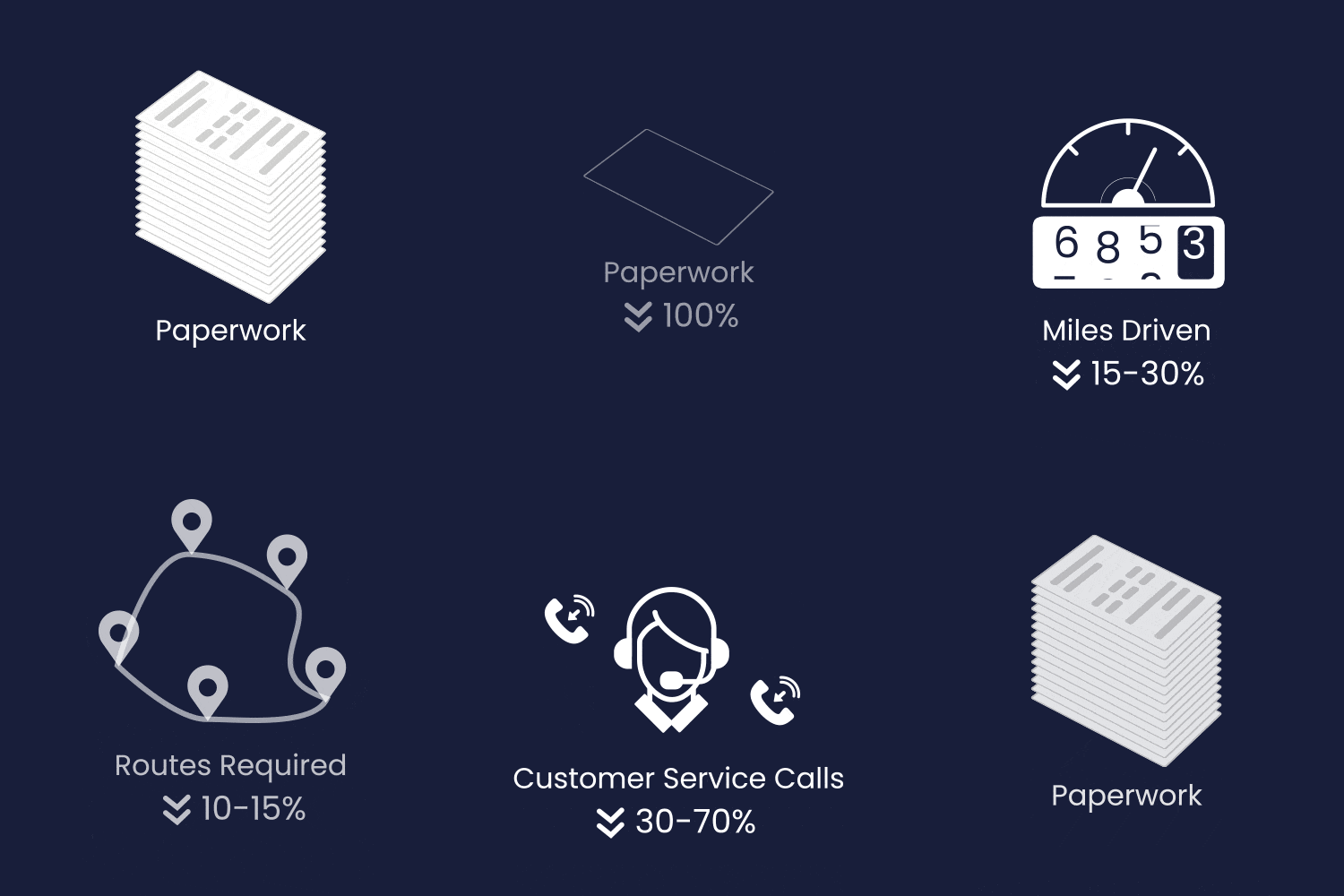
Fuel bills rising faster than your delivery volume? Reduce miles instantly
Key Benefits of AI Upgrades in Logistics
Investing in AI isn’t just about modernizing your logistics platform — it’s about transforming the way your entire supply chain operates. When AI is integrated into your route optimisation software, last mile delivery solutions, and TMS platforms, it unlocks measurable improvements across cost efficiency, delivery performance, scalability, and customer satisfaction.
Here are the most important benefits you gain from an AI-powered upgrade:
✔ Lower Operational Costs
AI reduces unnecessary mileage, fuel consumption, and manual labor by optimizing routes, predicting failures, and automating routine tasks.
With smarter decisions made in real time, businesses see a significant drop in:
- Fuel usage
- Maintenance expenses
- Driver overtime
- Inefficient asset utilization
For companies managing fleets or high-volume delivery operations, AI-driven routing and planning create immediate cost savings that compound over time.
✔ Higher On-Time Delivery Performance
AI-optimized routing engines generate the most efficient path based on live traffic, weather, road closures, and historical delivery patterns.
This results in:
- More accurate ETAs
- Better delivery predictability
- Reduced delays and detours
Whether you’re using delivery route planning software or a last mile TMS platform, AI ensures your drivers stay on schedule — even on the busiest days.
✔ Fewer Exceptions and Disruptions
AI allows logistics teams to move from reactive firefighting to proactive management.
It improves operational stability by providing:
- Real-time exception alerts
- Predictive issue detection
- Automated corrective workflows
From failed delivery attempts to vehicle breakdowns, AI identifies problems early and helps resolve them faster, keeping your network running smoothly.
✔ Better Customer Experience
Modern customers expect visibility, speed, and reliability — and AI delivers all three.
AI-powered platforms offer:
- Live shipment tracking
- Predictive ETA updates
- Proactive communication
- Higher delivery accuracy
This transparency builds trust and significantly improves customer satisfaction and loyalty.
✔ Scalable Last-Mile Operations
Manual processes fall apart when volumes rise — AI ensures your logistics network can grow without friction.
Automation supports scalability by:
- Eliminating repetitive tasks
- Improving dispatcher productivity
- Enhancing driver efficiency
- Supporting more orders without additional workforce
With AI integrated into your route management software or logistics route planning software, scaling your last-mile operations becomes easier, faster, and far more cost-effective.
Want to modernize your U.S. logistics operations with smarter automation?
Explore AI advantagesHow nuVizz Powers AI-Driven Last-Mile Delivery
nuVizz brings AI and automation to the core of delivery logistics, enabling organizations to move from reactive, manual operations to a fully optimized, intelligent last-mile ecosystem. As an end-to-end last mile delivery platform, nuVizz integrates advanced machine learning models, real-time data processing, and predictive insights to streamline delivery workflows at scale.
Here’s how nuVizz delivers AI excellence across every stage of the delivery lifecycle:
🔹 AI-Powered Route Optimization
nuVizz’s AI-driven routing engine continuously evaluates millions of variables to build the most efficient routes possible.
Key capabilities include:
- Dynamic route optimization based on traffic, weather, and delivery priority
- Real-time recalculations when stops change or exceptions occur
- Intelligent batching & multi-stop planning
- Cluster-based route generation for dense delivery zones
By integrating with your fleet, capacity, and constraints, nuVizz functions as one of the most advanced route optimization tools in the market — reducing miles traveled, lowering fuel costs, and boosting on-time delivery rates.
🔹 Predictive Visibility Platform
Visibility is core to modern logistics, and nuVizz delivers a real-time control tower experience with AI at its heart.
Its visibility capabilities include:
- Live GPS tracking with predictive ETAs
- Proactive delay alerts & exception forecasting
- AI-driven anomaly detection to flag issues early
- Real-time customer notifications for complete transparency
This level of predictability ensures fewer disruptions, faster decision-making, and a significantly improved customer experience.
🔹 Demand Forecasting & Capacity Planning
nuVizz uses AI to analyze historical data, sales patterns, seasonal spikes, and real-time inputs to forecast demand accurately.
This supports:
- Smarter capacity allocation
- Better driver and fleet planning
- Optimized resource utilization
- Reduced last-minute operational stress
By syncing forecasting with routing and dispatch, nuVizz brings intelligence to both strategic planning and day-to-day operations.
🔹 AI-Based Dispatch Automation
Manual dispatching is slow and error-prone — nuVizz automates it end-to-end.
Capabilities include:
- Automated driver assignment based on availability, proximity, and performance
- Load balancing for multi-driver or multi-region operations
- Cluster identification for efficient route grouping
- AI-driven performance optimization across routes, drivers, and vehicles
This ensures dispatchers can scale operations effortlessly without increasing overhead.
🔹 OCR & Intelligent Document Processing
nuVizz eliminates paperwork bottlenecks with advanced AI-powered document automation.
Features include:
- OCR-based ingestion of PODs, invoices, BOLs, and settlement documents
- Automated data extraction & validation
- Instant reconciliation for billing and settlement processes
- Reduced manual errors and processing delays
This makes nuVizz a powerful platform for integrating delivery execution with back-office workflows.
The Result: AI That Transforms the Entire Last Mile
With nuVizz, organizations aren’t just upgrading software — they’re modernizing the entire delivery lifecycle.
AI-driven capabilities help:
- Eliminate manual processes
- Reduce operational costs
- Improve route efficiency
- Deliver real-time visibility
- Boost customer satisfaction
- Support scalable last-mile expansion
nuVizz powers the intelligent automation needed to compete in a fast-changing logistics world.
Conclusion: Upgrade Now for a Competitive Edge
The signs are unmistakable — outdated logistics software creates bottlenecks that slow growth, reduce delivery accuracy, and increase operational costs. Whether it’s inconsistent forecasting, inefficient routing, limited visibility, reactive fleet maintenance, or heavy manual workloads, these challenges directly impact your ability to compete in today’s fast-moving logistics landscape.
AI is no longer a futuristic add-on. It’s the foundation of modern logistics.
The logistics leaders of 2025 are already embracing AI to operate faster, smarter, and more efficiently, transforming everything from route planning and dispatch to visibility, fleet management, and customer experience. Companies that delay AI adoption risk falling behind competitors who are optimizing every mile, every resource, and every decision with intelligent automation.
If your logistics platform is showing any of the five warning signs covered in this blog, the smartest move is to upgrade now — before inefficiencies grow further.
And when it comes to building an AI-powered logistics ecosystem, nuVizz is the partner that delivers end-to-end intelligence, from real-time visibility to route optimisation software, automated dispatching, predictive planning, and AI-driven document workflows.
Modernize your last-mile delivery operations today.