The logistics and supply chain landscape in the USA is undergoing its most transformative period in decades. From shifting consumer expectations to heightened competition and increasing economic uncertainty, businesses today face a level of operational pressure like never before. Retailers, distributors, healthcare networks, food logistics companies, and eCommerce brands are all navigating challenges such as:
- Rising transportation and fuel costs
- Severe driver shortages
- Unpredictable demand patterns
- Complex last mile delivery requirements
Increasing customer expectations for real-time visibility
- Fragmented operational processes across teams, partners, and carriers
In this environment, traditional logistics systems and manual processes can no longer keep up. Businesses are turning to AI logistics platforms to modernize operations, extract real-time intelligence, automate decision-making, and unlock efficiency at scale.
Artificial Intelligence is no longer a “nice to have.” It has become a core capability that powers the next generation of logistics—enabling smarter routing, automated workflows, predictive insights, optimized fleet utilization, and complete end-to-end visibility.
AI is transforming how logistics companies plan, execute, monitor, and optimize operations—especially in critical areas like:
- Last mile delivery optimization
- Routing and scheduling automation
- Predictive ETAs & real-time transportation visibility
- Dynamic dispatching & capacity planning
- Freight billing, settlement, and TMS automation
As we move through, AI-powered logistics platforms in the USA are quickly emerging as the cornerstone of smart supply chains, helping organizations reduce costs, boost service levels, and improve operational resilience.
In this blog, we explore the top 5 benefits of using an AI logistics platform in the USA, supported with real-world applications, industry trends, and how advanced platforms like nuVizz are enabling scalable, intelligent logistics for businesses of every size.
Understanding AI in Logistics: What Does It Really Mean?
AI in logistics is more than automation. It brings machine learning, deep learning, predictive analytics, and generative AI together to optimize every layer of the supply chain. Instead of relying on static rules, an AI-driven logistics platform continuously learns from data and adapts instantly to changing delivery conditions.
AI enhances key logistics functions such as:
- Route planning & dynamic re-sequencing
- Demand forecasting & load optimization
- Real-time visibility & predictive ETAs
- Automated exception management
- Freight billing & settlement accuracy
- Customer communication automation
- Supply chain decision intelligence
- Labor & fleet productivity optimization
- Address intelligence & geocoding
At its core, an AI logistics platform acts as a digital brain. It analyzes GPS movement, traffic behavior, historical delivery patterns, customer habits, and environmental factors to make fast, accurate decisions. This helps logistics teams operate with greater precision, fewer errors, lower costs, and higher delivery performance—essential for modern supply chain operations in the USA.
Top 5 Benefits of Using an AI Logistics Platform
The U.S. logistics landscape is evolving at a pace never seen before. Rising transportation costs, stricter customer SLAs, fluctuating demand patterns, labor shortages, and expanding delivery networks have made operations more complex and expensive for every segment—retail, healthcare, distribution, food & beverage, and eCommerce.
In this environment, AI logistics platforms are becoming essential for building resilient, efficient, and scalable operations. Unlike traditional systems that rely on static rules or manual decision-making, artificial intelligence in logistics empowers companies to interpret real-time conditions, predict future disruptions, and automate end-to-end workflows with unprecedented accuracy.
AI-powered logistics platforms in the USA help businesses:
- Break away from manual processes and legacy Last Mile TMS limitations
- Use real-time data, machine learning, and predictive analytics for smarter decisions
- Automate critical workflows like routing, dispatching, exception management, billing, and capacity planning
- Deliver faster, more accurate, and more customer-centric last-mile experiences
- Reduce waste, minimize empty miles, optimize fleets, and cut operational costs
From dynamic route optimization and predictive visibility to labor productivity and automated freight settlement, AI is redefining how American logistics networks operate.
The following five benefits highlight the most important and transformative impacts of adopting an AI-powered logistics platform—helping U.S. companies enhance service levels, improve margins, and compete in an increasingly digital, fast-moving supply chain environment.
1. Predictive, Real-Time Visibility for Proactive Supply Chain Control
Visibility continues to be one of the biggest challenges for U.S. logistics companies, especially in the last mile where delivery conditions change rapidly. While traditional tracking tools only show what has already happened, AI in logistics enables predictive visibility—allowing businesses to anticipate disruptions and take corrective action before service levels are impacted.
How AI Enhances End-to-End Visibility
AI-powered logistics platforms constantly analyze real-time and historical data to generate proactive insights such as:
- Predicting potential delays using traffic, weather patterns, driver behavior, and local delivery conditions
- Forecasting arrival times with near-perfect ETA accuracy
- Identifying at-risk orders even before dispatch
- Auto-flagging exceptions like route deviations, excessive idle time, or compliance violations
- Monitoring multi-stop and multi-leg movements with intelligent alerts and exception recommendations
These capabilities transform visibility from a static tracking layer into a live intelligence system.
Impact on U.S. Operations
Given the complexity of logistics in the United States—dense urban zones, long-haul interstate networks, regional carrier ecosystems, and rising SLA pressures—AI-driven visibility helps companies:
- Increase OTIF (On-Time-In-Full) performance
- Reduce detention, layover, and demurrage costs
- Maintain compliance with state and federal transportation regulations
- Proactively notify customers with accurate, dynamic updates
- Prevent downstream delays across hubs, terminals, and last-mile routes
With AI, visibility becomes a predictive decision engine, empowering logistics teams to stay ahead of disruptions and maintain consistent, reliable delivery performance across the U.S. supply chain.
2. AI Route Optimization That Recalculates Deliveries in Real Time
U.S. transportation networks are inherently unpredictable—ranging from multi-lane interstate highways and dense urban congestion to rural accessibility challenges, fluctuating driver availability, and weather-related disruptions. In this environment, traditional routing tools fall short. AI for logistics brings dynamic, real-time intelligence to route planning, enabling logistics teams to respond instantly to conditions on the ground.
What AI Routing Achieves
AI-powered route optimization engines evaluate millions of variables simultaneously, generating the most efficient and reliable delivery paths. Key capabilities include:
- Creating optimal routes using real-time traffic, weather, and operational constraints
- Learning micro-level patterns, such as building access delays, neighborhood restrictions, or gated community rules
- Automatic stop re-sequencing as conditions change during the route
- Recommending delivery-time adjustments based on predicted success rates
- Balancing fuel, time, cost, and SLA priorities for every stop
- Adapting routes for EV vs. diesel fleets, factoring in charge levels, range, and charging locations
- Predicting dwell and service times at each stop to improve accuracy
This transforms routing into a continuously updated, highly adaptive system rather than a one-time calculation.
Business Impact
Companies adopting AI-driven route optimization in the USA see immediate productivity and cost benefits, including:
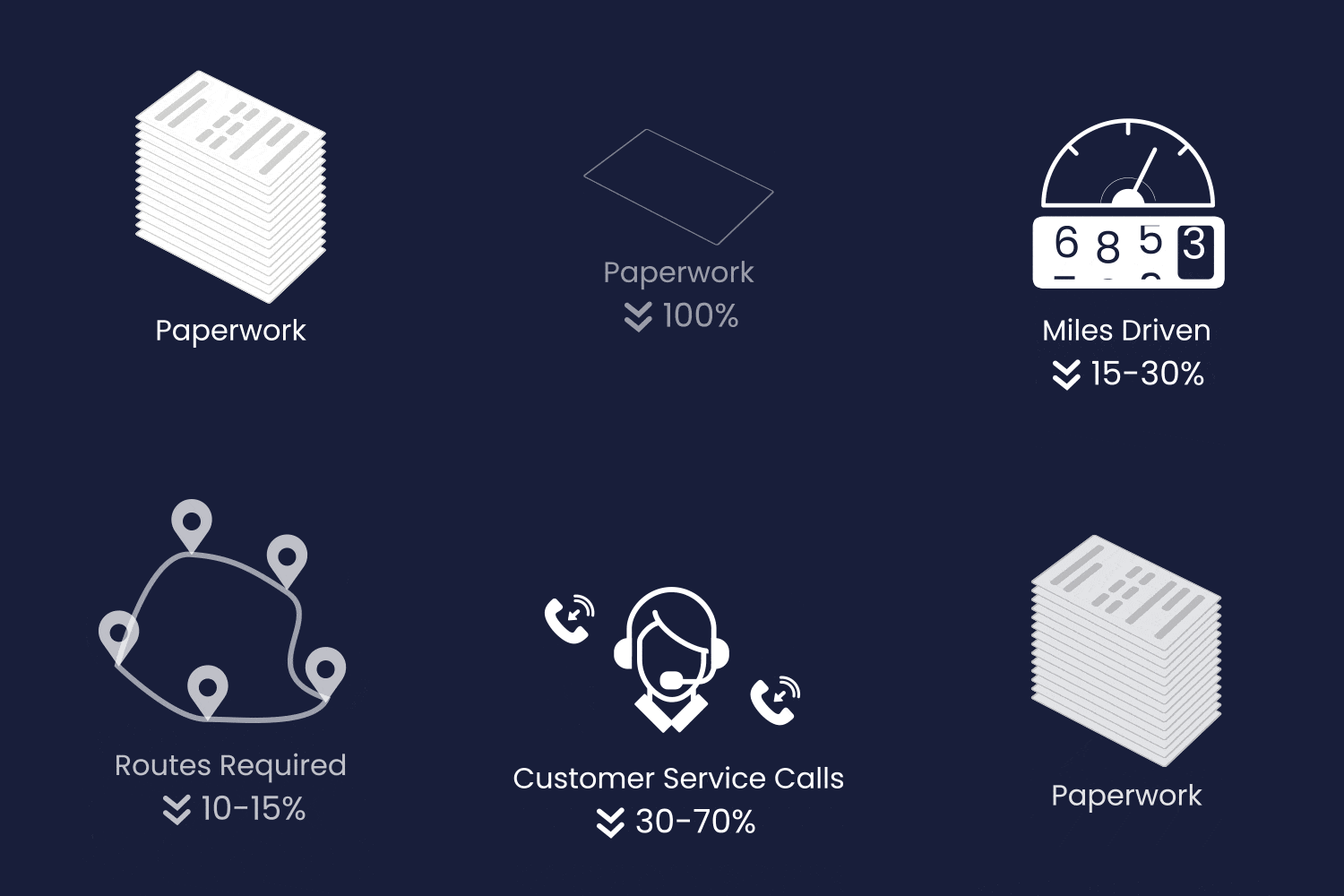
- 10–25% reduction in miles driven
- 15–30% decrease in fuel consumption
- Fewer routing errors and failed deliveries
- Higher driver productivity and balanced workloads
- Planning cycles that shrink from hours to minutes
By recalculating in real time, AI elevates routing from a manual planning task into a living, self-adjusting engine—delivering faster, more predictable, and more cost-efficient operations across the U.S. supply chain.
Want to discover smarter, more efficient routing and operations with AI? This article shows you how.
See How AI Transforms TMS3. Autonomous Exception Management (Zero-Touch Logistics)
Across the United States, an estimated 12–18% of deliveries encounter avoidable disruptions—from inaccurate addresses and customer unavailability to traffic incidents, missed dock times, and weather-related delays. Traditionally, operations teams spend hours manually handling these exceptions, leading to higher costs and reduced delivery efficiency.
With artificial intelligence and logistics coming together, exception management becomes smarter and largely autonomous. AI detects issues early, recommends corrective actions, and in many cases resolves the problem automatically—without human intervention.
AI-Powered Exception Management Includes
- Auto-rescheduling failed or future-risk deliveries
- Real-time assignment of alternate drivers or assets
- Smart selection of nearby micro-hubs for temporary storage or rerouting
- AI-based detection of faulty, incomplete, or risky addresses
- Instant customer outreach with updated delivery options
- Prioritization of high-risk shipments using behavioral and historical data patterns
These capabilities turn exception handling into a proactive, automated workflow instead of a manual, reactive process.
USA-Specific Benefits
The complexity of U.S. logistics—high-density cities, long-haul movements, multi-carrier ecosystems, and strict SLA expectations—makes autonomous exception management especially valuable. Key advantages include:
- Lower customer service workload due to fewer inbound issue calls
- Reduced failed delivery rates, particularly in urban metros like NYC, LA, Chicago, and Houston
- Fewer delays for critical sectors such as healthcare, pharmacy, and food logistics
- Lower reverse logistics and return shipping costs
- Greater efficiency in same-day and next-day delivery networks
AI enables logistics operations to self-heal in real time, creating a true zero-touch logistics environment where most disruptions are resolved automatically—long before they impact customer satisfaction or SLAs.
4. AI-Powered Freight Billing, Settlement & Cost Accuracy
Freight billing complexity is a major challenge in the U.S. logistics ecosystem. With varying mileage calculations, fluctuating accessorials, detention fees, last-mile surcharges, and multiple carrier rate cards, billing discrepancies occur frequently—leading to disputes, delayed payments, and revenue leakage.
AI transforms this entire workflow by automating billing at the source, ensuring accuracy and financial transparency across every shipment and route.
How AI Optimizes Billing
AI-driven billing engines validate financial data in real time and eliminate manual intervention. Key capabilities include:
- Cross-validating route data with telematics, ensuring mileage, stop times, and dwell times are accurate
- Automatically matching rate cards, carrier contracts, and customer-specific rules
- Detecting anomalies or inflated charges before invoices are released
- Auto-generating 100% accurate invoices with line-item clarity
- Automating carrier settlement for faster, dispute-free reconciliation
- Providing lane-level profitability insights to improve pricing and margin strategies
With AI, billing becomes consistent, compliant, and fully traceable.
Results for American Logistics Companies
The impact on U.S. operations—where cost variability is high and multi-carrier ecosystems are common—is significant:
- Faster cash cycles due to automated invoice generation
- Fewer billing disputes with carriers and customers
- Accurate, audit-ready financial reporting
- Reduced revenue leakage from missed charges or incorrect billing
- Improved bottom-line profitability, especially in last-mile and multi-stop operations
AI elevates freight billing from a manual frustration into a fully automated financial engine, enabling logistics companies to operate with greater accuracy, transparency, and confidence.
5. Operational Scalability Through Intelligent Resource Utilization
Scaling logistics operations in the U.S. has always required significant investment in fleet, labor, and administrative capacity. But with the rise of AI logistics platforms, companies can now expand efficiently—without proportionally increasing resources or overhead. AI enables smarter utilization of drivers, assets, warehouse staff, and transportation infrastructure, ensuring operations remain agile even under extreme demand pressure.
How AI Improves Resource Utilization
AI-driven optimization engines help logistics teams use existing resources more effectively across the end-to-end supply chain:
- Driver assignment & shift scheduling based on skill, availability, and delivery zone performance
- Higher fleet utilization through balanced routing, reduced empty miles, and improved load allocation
- Optimized warehouse picking and packing, supported by predictive workload distribution
- Smarter dock scheduling to avoid bottlenecks and reduce truck dwell time
- Improved multi-modal load planning for LTL, FTL, parcel, and middle-mile networks
- Seamless handling of high-volume peak seasons through predictive planning and automated capacity adjustments
AI ensures every asset—human or physical—is deployed at maximum efficiency.
Why This Matters in the U.S.
The U.S. logistics landscape experiences some of the world’s most intense demand fluctuations, including:
- Black Friday & Cyber Monday surges
- Holiday peak season (Christmas & New Year)
- Seasonal produce peaks
- Back-to-school cycles
- Retail promotions and flash sales
AI helps companies absorb these volume spikes without operational chaos by:
- Accurately forecasting demand weeks in advance
- Recommending future resource allocation, including labor, fleet, and warehouse throughput
- Balancing diverse fleet types (EVs, vans, box trucks, 2-wheelers) based on delivery density
- Preventing labor shortages with predictive staffing models
- Reducing warehouse congestion during inbound and outbound peaks
The result is a logistics network that is not only resilient but scalable at every layer—from first mile to last mile.
AI elevates the entire supply chain into a future-ready, self-optimizing ecosystem, enabling U.S. logistics companies to grow faster while maintaining service levels, efficiency, and profitability.
Learn how top logistics teams use delivery-exception analytics to reduce errors and boost on-time performance. Read the Full Guide
Additional Advantages of AI in Logistics (Beyond the Top 5)
While the primary benefits outline how AI transforms core logistics operations, modern AI logistics platforms offer several advanced capabilities that further strengthen supply chain performance, customer satisfaction, and operational intelligence.
1. Hyperlocal Delivery Intelligence
AI models learn zone-level, street-level, and even building-level delivery patterns, helping logistics teams optimize micro-routes in dense urban areas.
This improves:
- Delivery accuracy
- Parking time prediction
- Building access time estimation
- Driver efficiency in complex U.S. metros
This directly strengthens last mile delivery route optimization and lowers delivery variability.
2. AI-Powered Digital Twins for Predictive Planning
AI creates a virtual replica of your logistics network to simulate:
- Delivery demand fluctuations
- Route congestion
- Weather disruptions
- Fleet mix changes
- Warehouse load and labor requirements
Digital Twins help companies test strategies before execution—reducing cost, improving accuracy, and enabling smarter transportation route planning.
3. Sustainability Optimization & Carbon Reduction
With pressure mounting for cleaner transportation in the USA, AI plays a critical role.
AI optimizes:
- Fuel consumption
- Idle time
- Route distance
- Fleet mix (EV vans, hybrid vehicles, etc.)
- Empty miles
This not only supports sustainable last mile logistics but also lowers operating costs significantly.
4. Driver Behavior Analytics & Safety Intelligence
AI models track driver behavior patterns such as:
- Harsh braking
- Idle and dwell time
- Acceleration patterns
- Late departures
- Delivery speed
- Parking behavior
This helps logistics teams implement safety programs, reduce insurance costs, and improve delivery quality—making it ideal for B2B delivery operations, healthcare logistics, retail, and more.
5. Better Customer Experience with Predictive Insights
AI enhances end-customer satisfaction with features like:
- Real-time shipment visibility
- Hyper-accurate ETA predictions
- Dynamic notifications
- Self-service delivery portals
- Proactive delay alerts
This elevates the overall experience, which is essential for the U.S. eCommerce and retail market, where customer expectations are extremely high.
How nuVizz Leads the Future of AI-Powered Logistics
Before we conclude, it’s important to highlight why nuVizz stands out as one of the most advanced AI-powered logistics platforms in the United States. nuVizz delivers an end-to-end ecosystem that brings together AI route optimization, real-time visibility, delivery orchestration, billing automation, and predictive intelligence—making it a leader in last-mile, middle-mile, healthcare, and enterprise logistics.
How nuVizz Uses AI to Transform Logistics
nuVizz embeds artificial intelligence across every stage of the logistics lifecycle, enabling smarter decisions, faster deliveries, and highly automated operations.
1. Intelligent Route Planning & Real-Time Re-Sequencing
AI continuously processes traffic, weather, driver behavior, customer time windows, dock schedules, and fleet constraints to generate the most efficient routes.
Dynamic re-sequencing helps fleets adapt instantly to disruptions—improving on-time performance and reducing miles.
2. Predictive Visibility Across All Delivery Legs
nuVizz offers end-to-end predictive ETAs, real-time GPS tracking, customer visibility portals, and multi-party shipment insights.
This reduces visibility gaps across first-, middle-, and last-mile movements.
3. Automated Exception Management
AI automatically identifies, prioritizes, and resolves delivery disruptions such as delays, missed scans, failed attempts, or route deviations.
This reduces manual workload and increases delivery success rates significantly.
4. AI-Driven Billing & Settlement Automation
nuVizz validates:
- Miles driven
- Planned vs. actual stops
- Driver shift logs
- Wait time & detention
- Accessorial charges
- Rate-card rules
This ensures 100% accurate invoice creation and settlement reporting, eliminating billing disputes and lost revenue.
5. Multi-Modal & Multi-Network Logistics Optimization
nuVizz supports complex U.S. logistics operations involving:
- EV fleets
- Vans & box trucks
- Specialty delivery vehicles
- Temperature-controlled units
- Gig-economy drivers
- Multi-region carrier networks
AI ensures the right fleet mix and optimal resource utilization for every load and geography.
6. Digital Twins & Predictive Analytics
Using digital twin simulations, nuVizz enables logistics organizations to test “what-if” scenarios, validate capacity plans, forecast volume surges, and prepare for U.S. peak-season fluctuations like Black Friday, Cyber Monday, and seasonal produce cycles.
Who Benefits from nuVizz?
nuVizz is designed for fast-growing and complex logistics networks, including:
- Retailers & eCommerce companies
- Healthcare & pharmaceutical distributors
- Food, beverage & grocery logistics
- Field service & home delivery providers
- B2B distribution networks
- White-glove & final-mile delivery specialists
- 3PLs, regional carriers & national transportation providers
The nuVizz Advantage
With a proven track record across, nuVizz helps logistics teams:
- Reduce delivery costs
- Maximize fleet efficiency
- Improve driver performance
- Enhance customer experience
- Increase billing accuracy
- Achieve real-time visibility across the entire supply chain
Powered by next-generation AI, nuVizz is transforming how modern logistics operations plan, execute, optimize, and scale.
Conclusion: AI Is the Competitive Advantage for U.S. Logistics
Artificial intelligence is quickly becoming the defining competitive advantage for logistics companies in the United States. As transportation networks grow more complex and customer expectations rise, AI empowers organizations to move beyond traditional planning and embrace predictive, automated, and self-optimizing logistics operations.
By adopting a modern AI logistics platform, businesses can unlock measurable improvements across every stage of their delivery lifecycle:
- Higher first-attempt delivery success rates
- Lower cost per mile and reduced fuel consumption
- Faster, more accurate freight billing and settlement
- Autonomous exception detection and zero-touch resolution
- Improved customer experiences with real-time visibility
- Scalable operations that handle peak-season demand effortlessly
- Actionable insights that drive smarter decision-making
Platforms like nuVizz are at the forefront of this shift, combining deep domain expertise with next-generation AI to help U.S. logistics companies deliver smarter, faster, greener, and more profitably. As AI continues to evolve, early adopters will gain a long-term advantage—building supply chains that are resilient, efficient, and ready for the future.