In today’s fast-moving logistics landscape, efficiency is everything. Whether you manage a small courier startup or a large-scale delivery network, having the right courier delivery software is no longer a luxury — it’s a business necessity. With rising customer expectations for real-time visibility, faster delivery times, and accurate tracking, manual processes and disconnected systems can quickly become major roadblocks to growth.
Modern businesses need more than just basic delivery scheduling — they need intelligent route optimization, automated dispatching, and end-to-end last mile visibility. The right delivery route planning software not only streamlines day-to-day operations but also enhances customer satisfaction, reduces costs, and boosts delivery efficiency.
In this comprehensive guide, we’ll walk you through exactly how to choose the best courier delivery software for your business. From understanding essential features to evaluating integration capabilities and vendor support, you’ll discover what truly matters when selecting a scalable, future-ready solution. Whether you’re upgrading from manual tools or replacing outdated systems, this guide will help you make a confident, data-driven decision.
Why Investing in Delivery or Courier Software Is Critical
The success of any courier or logistics business hinges on operational precision and customer satisfaction. As delivery volumes surge and customer expectations rise, relying on manual scheduling, phone-based dispatch, or basic spreadsheets can quickly lead to missed deadlines, underutilized fleets, and unnecessary expenses. That’s where modern courier delivery software makes all the difference — transforming your delivery operations from reactive to proactive.
1. Operational Efficiency & Cost Savings
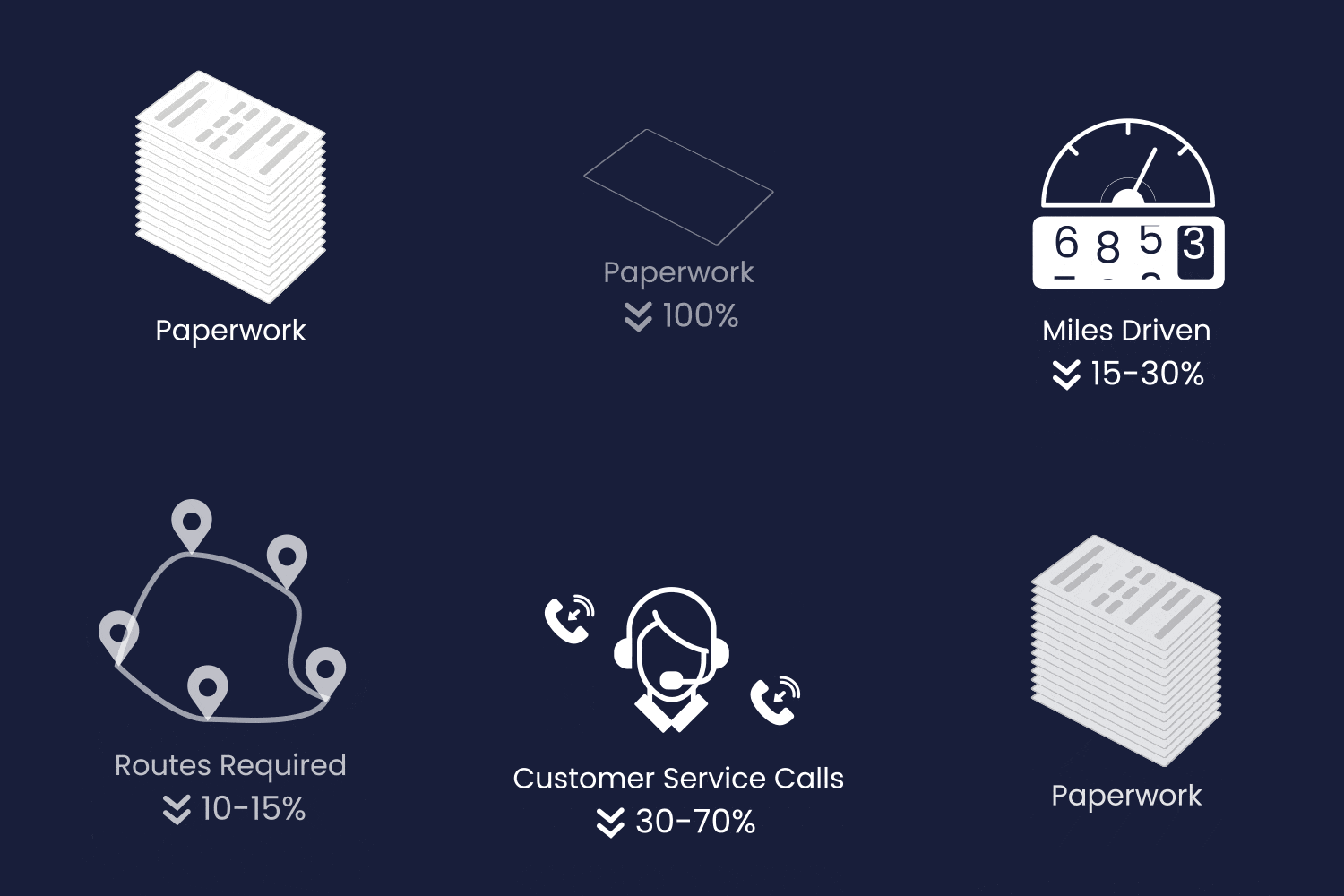
Automating your route planning, dispatch, and scheduling processes drives tangible savings across every mile. Intelligent route Optimization software helps reduce unnecessary travel distances, lower fuel consumption, and minimize driver idle time. By eliminating manual errors and optimizing fleet utilization, businesses can often cut operational costs by up to 20–30%. Whether you’re managing 10 vehicles or 1,000, delivery routing software ensures every route is efficient, timely, and profitable.
2. Better Customer Experience
In today’s on-demand economy, visibility equals trust. Real-time tracking, dynamic ETA notifications, and transparent updates empower customers with the information they expect. Platforms like Onfleet and Upper Route Planner have set high standards for communication and visibility, showing how the right last mile delivery software can drastically reduce support calls and enhance the customer experience. When customers know exactly when their package will arrive, satisfaction — and loyalty — naturally follow.
3. Scalability and Flexibility
As your delivery network expands, managing additional stops, vehicles, and orders manually becomes unsustainable. Scalable delivery route planning software adapts to your growth — supporting multiple hubs, varied delivery types, and custom workflows without slowing down operations. Tools illustrate how a well-designed routing optimization software can seamlessly scale with your business, ensuring you’re ready for peak seasons or sudden spikes in demand.
4. Data-Driven Decision Making
Modern courier software goes beyond execution — it delivers intelligence. Integrated reporting and analytics dashboards help businesses track KPIs such as delivery times, driver performance, and fuel usage. Insights from platforms enable managers to identify inefficiencies, improve route performance, and optimize driver productivity. Over time, these data-driven improvements directly contribute to lower costs, faster deliveries, and a more agile logistics operation.
5. Benefits for Small and Medium Businesses (SMBs)
Courier delivery technology isn’t just for enterprise logistics providers. Many vendors today specialize in delivery software for small businesses, offering flexible pricing, intuitive dashboards, and easy onboarding. Whether you operate a local courier service, food delivery fleet, or eCommerce fulfillment network, implementing route management software can help you scale efficiently without adding complexity or overhead.
Common Use Cases & Business Types
Before investing in a new courier delivery software, it’s essential to understand your business model and delivery workflows. The ideal platform for a hyperlocal courier service may look very different from what an eCommerce retailer or nationwide logistics provider needs. By identifying your delivery structure and operational scale, you can choose the best route planning software that truly fits your business goals.
1. Local & Same-Day Couriers
Speed and accuracy are everything in same-day delivery. Local couriers need dynamic route optimization, auto-dispatch capabilities, and proof-of-delivery (POD) tools to maintain service reliability. A robust route optimization tool can automatically assign deliveries based on driver proximity, vehicle capacity, and real-time traffic — ensuring your customers get their parcels faster while minimizing idle time and fuel waste.
2. eCommerce Retailers with In-House Delivery
For eCommerce businesses managing their own last-mile operations, integration is key. Your delivery routing software should connect seamlessly with your order management system (OMS) or eCommerce platforms. With features like delivery window management, real-time tracking, and automated route scheduling, retailers can handle order surges during sales or festive seasons while keeping delivery promises intact.
3. Small and Medium Businesses (SMBs) or Startups
Smaller operations often need simplicity and affordability without compromising performance. The best last mile delivery solutions for SMBs offer intuitive dashboards, drag-and-drop scheduling, and quick onboarding. Cloud-based route management software provides flexibility for growing businesses — allowing you to start small and scale up as delivery volumes increase, without heavy infrastructure costs.
4. Large Fleets & Multi-Region Logistics Providers
For enterprises or 3PL providers managing large fleets across regions, scalability and control become top priorities. Advanced fleet route planning software offers features such as zone-based routing, driver analytics, multi-hub management, and delivery performance dashboards. These tools enable large-scale logistics operations to optimize thousands of deliveries daily, balance workload distribution, and maintain cost efficiency across territories.
5. Tailoring Features to Your Business Model
Every delivery model — whether on-demand (immediate dispatch) or batched delivery (scheduled or bulk routing) — demands a different level of automation and route intelligence. On-demand operations benefit most from real-time dispatch routing software, while batched deliveries thrive on route planning and optimization tools that cluster stops efficiently. Understanding your service model helps narrow down the feature set that aligns with your operational needs.
Key Features & Capabilities to Look For
Not all courier delivery platforms are created equal. The best courier and delivery management software does more than just track packages — it helps you orchestrate your entire delivery lifecycle with precision, visibility, and control. Here are the key features that set top-tier systems apart from basic tools.
1. Route Planning & Optimization
At the heart of any powerful delivery routing software lies advanced route planning and optimization. The system should function as a multi-route planner, capable of managing several drivers and delivery routes simultaneously. It must also serve as a multi-stop route planner, allowing multiple stops per trip while calculating the most time- and cost-efficient path.
Modern route optimization software leverages algorithms that factor in traffic conditions, delivery windows, driver breaks, vehicle capacity, and even real-time road restrictions. Solutions like nuVizz are known for their intelligent routing engines that help dispatchers reduce miles driven and improve on-time performance.
Additionally, dynamic re-routing support — which automatically adjusts routes based on last-minute changes, delays, or cancellations — is a major differentiator. This capability is crucial for maintaining efficiency in unpredictable last-mile delivery environments.
2. Delivery Scheduling & Auto-Dispatch
An effective route dispatch software should allow dispatchers to plan and schedule deliveries well in advance. Features like delivery time window selection ensure customers receive shipments exactly when expected.
Equally important is auto-dispatch functionality, which automatically assigns tasks to drivers based on proximity, delivery priority, or load capacity. Platforms excel in this area, offering AI-driven dispatch automation that reduces manual workload and speeds up delivery turnaround times.
For real-world flexibility, look for systems that offer dynamic rescheduling — the ability to automatically reassign routes or deliveries when faced with real-time disruptions like traffic or weather conditions.
3. Real-Time Tracking & Customer Notifications
Customer expectations for transparency have never been higher. A leading last mile delivery platform should provide real-time GPS tracking for both drivers and packages, giving customers full visibility from dispatch to doorstep.
Automated SMS and push notifications help customers stay informed about their delivery status, while live driver tracking helps build trust and reduce inbound “Where’s my order?” calls. Systems also give dispatchers complete operational visibility, allowing them to monitor active deliveries, intervene when necessary, and maintain a high level of control throughout the process.
4. Proof of Delivery & Digital Signatures
A strong last mile delivery solution should make proof-of-delivery (POD) collection simple and seamless. Drivers should be able to capture digital signatures, photos, notes, or barcode scans directly from their mobile device.
This digital proof should automatically sync to cloud storage for record-keeping and easy retrieval. Tools streamline this process, ensuring that every completed delivery is documented and verifiable — a must-have for B2B logistics and compliance-heavy industries.
5. Integration & API Support
Scalability in logistics depends on interoperability. The best delivery route planning software integrates effortlessly with your existing ecosystem — including order management systems (OMS), eCommerce platforms, CRMs, and warehouse management systems (WMS).
Solutions offer open APIs and webhooks for real-time data exchange, allowing your software to “talk” to third-party apps for payments, analytics, or mapping. This flexibility ensures your operations remain connected, automated, and future-proof.
6. Analytics, Reporting & Dashboards
In logistics, what gets measured gets optimized. Robust analytics and reporting tools are essential for evaluating performance across your delivery network. Key metrics such as on-time delivery rate, cost per delivery, deliveries per hour, and fleet utilization provide actionable insights.
Leading solutions provide intuitive dashboards that visualise this data, enabling managers to quickly identify bottlenecks or inefficiencies. Exportable reports allow deeper performance reviews or executive-level summaries for decision-making.
7. Flexibility, Scalability & User Experience
Finally, your delivery routing software should adapt as your business grows. From startups managing a few vehicles to enterprises operating multi-region fleets, scalability ensures that new routes, drivers, and regions can be added without major reconfiguration.
A user-friendly interface (for both dispatchers and drivers), mobile app support for iOS and Android, and high system uptime are must-haves. Leading platforms also offer customization options — allowing you to tailor workflows, branding, or reports to match your operational needs.
Ultimately, a reliable last mile delivery logistics solution not only simplifies daily operations but positions your business to handle growth confidently and efficiently.
How to Evaluate Vendors & Make a Decision
Once you have a shortlist, here’s how to compare them:
| Evaluation Area | What to Check | Questions to Ask |
| Usability & Onboarding | How steep is the learning curve? | Can your staff easily adopt the tool? Do they offer training or guided onboarding? |
| Pricing & Licensing | Transparent pricing (per driver, per route, per feature)? | Are there hidden costs (API, extra users, support)? |
| Support & Reliability | Response times, SLA, availability | What is their average uptime? Do they offer 24/7 support? |
| Customization & Scalability | Can modules be added or removed? | Will the tool adapt as your business grows? |
| References & Case Studies | Feedback from similar businesses | Can they show success stories, ROI metrics, or customer testimonials? |
About nuVizz
nuVizz is a leading provider of AI-powered transportation and delivery management solutions, designed to simplify complex logistics operations. From real-time visibility and multi-stop route optimization to automated dispatching and proof of delivery, nuVizz empowers businesses across industries — retail, healthcare, distribution, and eCommerce — to digitize and optimize every mile of their supply chain.
Our last mile delivery platform enables end-to-end control of delivery workflows, improves customer experience, and helps businesses achieve up to 20–30% efficiency gains through advanced route optimization and analytics.
With nuVizz, you get:
- Cloud-based scalability and seamless integration with ERP/TMS systems
- Real-time driver tracking and ETA alerts
- Dynamic route planning for multiple stops and fleets
- Analytics-driven insights for continuous improvement
- Proven ROI for businesses of all sizes
Whether you’re a small courier business or an enterprise-scale delivery network, nuVizz’s delivery management software gives you the agility, visibility, and intelligence you need to thrive in a competitive logistics landscape.
Learn more about nuVizz’s Delivery Management Solutions
Conclusion
Choosing the best courier delivery software isn’t about finding the one with the most features — it’s about finding the one that fits your business model, scale, and growth goals. The right solution will unify your delivery operations, optimize routes with multi-route planners, improve transparency with real-time tracking, and help you delight customers consistently.
Take your time evaluating platforms, ask the right questions, and look for a partner who understands your operational realities — not just a vendor selling software.