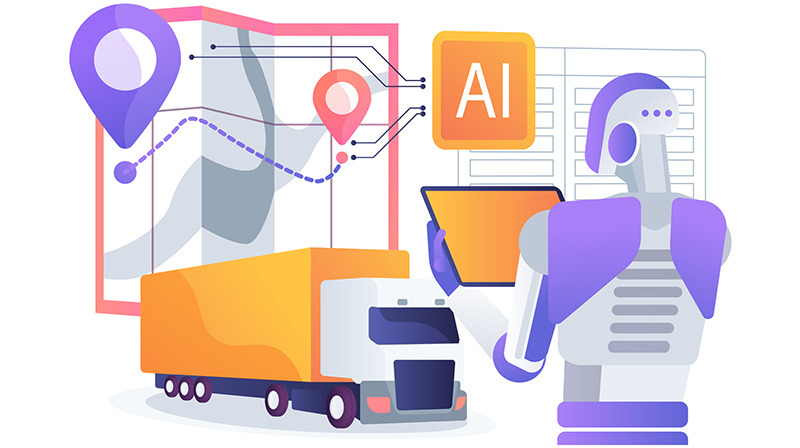
Artificial Intelligence (AI) is no longer a futuristic experiment in the logistics industry—it has become the intelligent backbone of modern supply chains. From predictive demand forecasting to real-time route optimization, AI is fundamentally reshaping how logistics networks plan, execute, and adapt. As global supply chains grow more complex and customer expectations rise, AI-driven logistics solutions are transitioning from optional innovations to mission-critical capabilities.
For logistics leaders, the conversation has evolved. The question is no longer whether AI will be adopted, but how quickly organizations can operationalize AI across transportation, warehousing, and last-mile delivery to stay competitive. Companies that delay AI integration risk higher operational costs, limited visibility, and reduced agility in responding to disruptions.
By 2026, AI in logistics is expected to move beyond isolated use cases and become deeply embedded across the end-to-end supply chain. Emerging technologies—such as generative AI, autonomous decision-making systems, real-time transportation visibility platforms, and self-learning route optimization software—will mature into foundational pillars of logistics execution. These systems will not only analyze data but continuously learn, predict outcomes, and recommend optimal actions in real time.
As a result, logistics organizations will see measurable gains in cost efficiency, delivery speed, sustainability, and customer satisfaction. This evolution will redefine how transportation management systems (TMS), last-mile delivery platforms, and logistics route planning software operate—shifting from reactive tools to proactive, AI-powered decision engines.
In this article, we explore the key AI logistics trends to watch in 2026, the technologies driving this transformation, and how forward-thinking logistics providers can prepare today to lead tomorrow’s AI-first supply chain.
How Artificial Intelligence Is Used in Supply Chains
Artificial Intelligence (AI) is widely used across modern supply chains to enable predictive analytics, intelligent automation, and real-time operational optimization. Rather than relying on static rules or historical averages, AI systems continuously analyze vast volumes of structured and unstructured data to help supply chains anticipate demand, reduce inefficiencies, and respond proactively to disruptions.
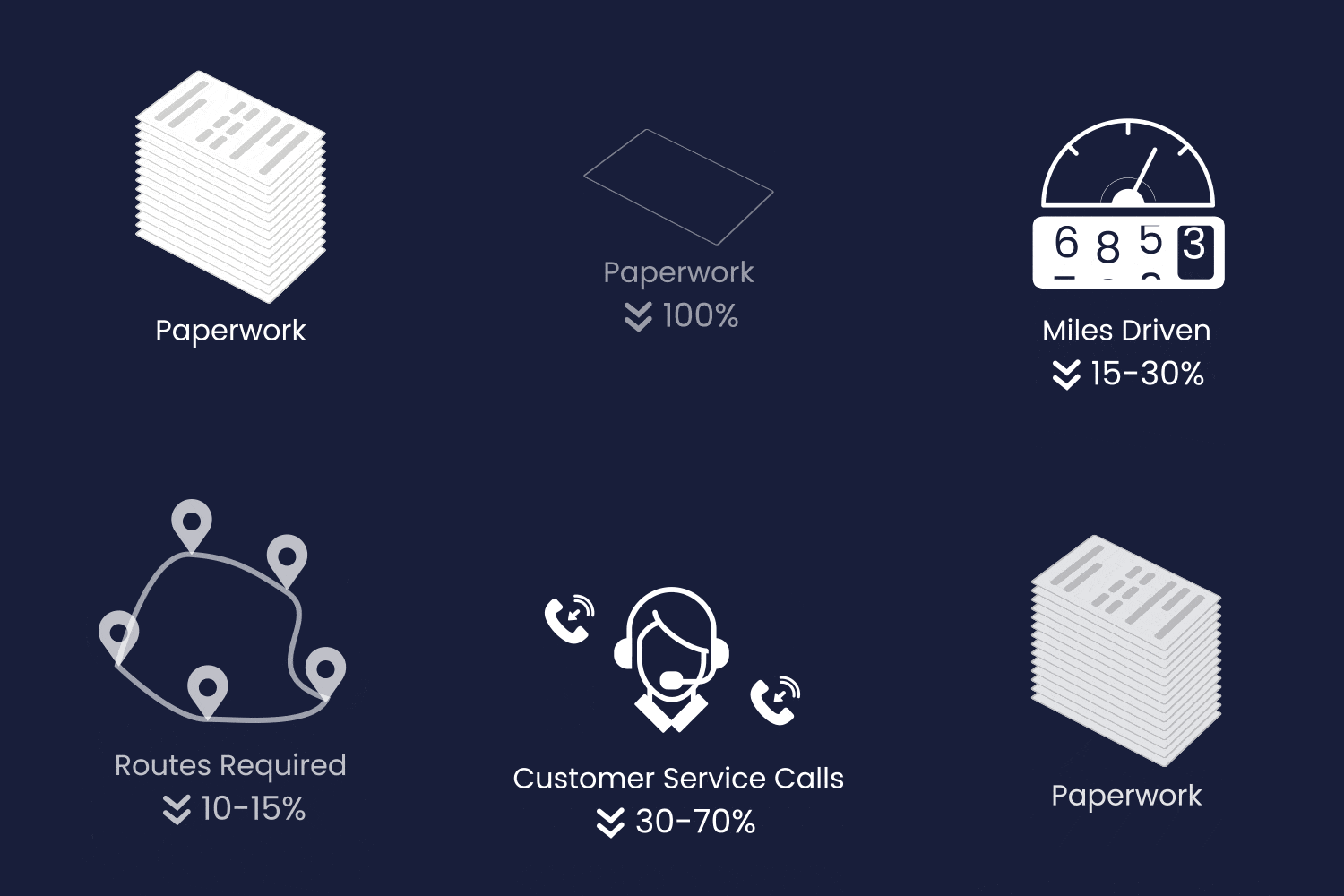
Today, AI-powered supply chain solutions are most commonly applied in areas such as warehouse optimization, demand forecasting, inventory management, automated customer support, and dynamic route planning. These applications are delivering measurable improvements in cost control, service levels, and sustainability—making AI a core component of next-generation logistics operations.
Key Applications of AI in Supply Chains
Artificial intelligence is applied across multiple layers of the supply chain to improve planning accuracy, execution efficiency, and real-time responsiveness. These AI-driven applications help organizations move away from reactive decision-making toward predictive and adaptive supply chain operations. By leveraging machine learning, computer vision, and real-time data processing, AI enables logistics teams to optimize inventory, automate warehouses, enhance transportation planning, and deliver a more reliable customer experience. The following applications represent the most impactful ways AI is being used in supply chains today—and how these capabilities are expected to evolve further by 2026.
Demand Forecasting
AI-driven demand forecasting uses machine learning models to analyze historical sales data, seasonality patterns, promotional activity, market signals, weather conditions, and even social media trends to predict future product demand with high accuracy. Unlike traditional forecasting methods, AI models continuously learn from new data, allowing businesses to:
- Anticipate demand spikes and drops earlier
- Reduce forecast errors and planning volatility
- Align production, inventory, and transportation strategies
By 2026, demand forecasting is expected to evolve into real-time, self-adjusting prediction systems that adapt instantly to market changes.
Inventory Management
AI enhances inventory management by determining optimal stocking levels, safety stock thresholds, and reorder points across multiple locations. By balancing demand variability, lead times, and service-level targets, AI helps organizations:
- Minimize carrying and holding costs
- Prevent costly stockouts and excess inventory
- Improve cash flow and warehouse space utilization
These AI-powered inventory optimization tools are especially valuable in omnichannel and last-mile delivery environments, where inventory accuracy directly impacts customer satisfaction.
Automated Warehousing
In warehouse operations, AI works alongside robotics, computer vision, and IoT sensors to automate sorting, picking, packing, and quality inspection processes. AI algorithms continuously analyze order patterns and movement data to optimize:
- Warehouse layout and slotting strategies
- Picking paths and labor allocation
- Throughput and order fulfillment speed
As labor constraints continue to challenge logistics providers, AI-enabled automated warehousing is becoming a critical driver of scalability and operational resilience.
Struggling with delays and inventory mismatches in retail logistics?
Explore SolutionsRoute Optimization
AI-powered route optimization software calculates the fastest and most cost-efficient delivery routes in real time, factoring in traffic congestion, delivery windows, vehicle capacity, weather conditions, and fuel consumption. Unlike static route planning, AI-driven routing systems dynamically re-optimize routes as conditions change, enabling logistics teams to:
- Reduce fuel usage and carbon emissions
- Improve on-time delivery performance
- Lower transportation and last-mile delivery costs
This capability is particularly impactful for last-mile delivery logistics, where small routing inefficiencies can significantly affect margins and customer experience.
Future of AI in Logistics
The future of AI in logistics will be driven by greater autonomy and deeper interconnectedness across supply chain systems. AI is evolving from a reporting tool into an active problem-solver, enabling what is known as a self-healing supply chain, where disruptions are identified and resolved in real time with minimal human intervention.
This shift will be powered by several key advancements:
- Advanced machine learning that continuously learns from operational data to improve predictions and decisions
- Digital twins that create real-time virtual models of logistics networks to simulate disruptions and test optimal responses
- Autonomous software agents that coordinate planning, execution, and exception management across systems
Together, these technologies will allow logistics organizations to operate with greater resilience, agility, and efficiency, making AI the central intelligence layer of future logistics operations.
How Will AI Reshape Logistics in 2026?
By 2026, AI will move beyond incremental improvements to strategically reshape logistics operations. Instead of supporting isolated processes, AI will connect data across planning, execution, and visibility systems to enable faster, smarter decision-making at scale.
AI will turn fragmented logistics data into real-time, actionable insights, allowing supply chains to operate proactively rather than reactively. This shift will help organizations respond instantly to disruptions while improving service reliability and cost efficiency.
Key ways AI will reshape logistics in 2026 include:
- Real-time decision automation: AI systems will detect issues and recommend or execute corrective actions without manual intervention.
- Cross-silo intelligence: Data from Last Mile TMS, warehouses, fleets, and customer channels will be unified for end-to-end visibility.
- Dynamic operations: Routes, inventory placement, and delivery schedules will continuously adjust based on live conditions.
- Customer-centric execution: Delivery promises, communication, and service levels will adapt in real time to meet customer expectations.
By enabling dynamic, proactive, and customer-focused supply chains, AI will become a strategic differentiator for logistics organizations in 2026.
Trend 1: From Predictive to “Agentic” AI
One of the most important AI trends in logistics for 2026 will be the shift from predictive AI to agentic AI. Traditional predictive AI focuses on forecasting outcomes—such as potential delays, demand spikes, or capacity shortages. Agentic AI goes a step further by deciding and acting on the best response automatically, transforming AI from a reporting tool into an autonomous operational partner.
This evolution allows logistics systems to respond to disruptions in real time rather than waiting for human intervention, significantly improving speed, resilience, and efficiency.
What Is Agentic AI in Supply Chain Management?
Agentic AI in supply chain management refers to autonomous, goal-driven software agents that can observe conditions, reason through multiple options, and execute actions independently. These AI agents operate based on high-level objectives rather than rigid rules.
Key capabilities of agentic AI include:
- Monitoring events such as port closures, demand surges, or route disruptions
- Making decisions based on cost, service levels, and operational constraints
- Executing actions like rerouting shipments, reallocating inventory, or adjusting capacity
- Adapting dynamically to multi-step and unpredictable scenarios
Unlike traditional automation, agentic AI uses reasoning, planning, and continuous learning, making it suitable for complex and fast-changing logistics environments.
From “Human-in-the-Loop” to “Human-on-the-Loop”
Most logistics organizations today operate under a Human-in-the-Loop (HITL) model, where AI provides recommendations but humans approve and execute decisions. While this ensures control, it often slows down operations and creates bottlenecks during time-sensitive situations.
By 2026, this model will shift toward Human-on-the-Loop (HOTL), where autonomous AI agents handle routine and urgent decisions independently. Human involvement will be limited to:
- High-risk or high-impact scenarios
- Novel or highly complex disruptions
- Strategic, ethical, or regulatory decisions
This transition from constant intervention to supervisory oversight will dramatically accelerate logistics execution while allowing human planners to focus on long-term strategy and optimization.
AI is redefining speed, accuracy, and cost in last-mile delivery. Discover How
Trend 2: The Rise of Hyper-Personalized Last-Mile Delivery
Last-mile delivery is the most expensive and customer-visible stage of the logistics chain, and in 2026, AI will shift its focus from simple efficiency to experience-driven delivery. Instead of treating all deliveries the same, AI will tailor the last-mile journey to individual customer preferences, expectations, and real-time conditions.
This transformation will turn last-mile delivery from a cost center into a key differentiator for customer satisfaction and brand loyalty.
How Can AI Improve Customer Delivery Experiences?
AI improves customer delivery experiences by optimizing every interaction between the brand and the customer. Rather than offering generic delivery promises, AI systems analyze behavior patterns, location data, and real-time execution signals to deliver more convenient and predictable outcomes.
Key ways AI enhances the delivery experience include:
- Predicting the most convenient delivery window, not just the fastest one
- Proactively identifying delays before customers are impacted
- Personalizing delivery instructions based on past preferences
- Communicating updates through the customer’s preferred channel (SMS, WhatsApp, app notifications, or email)
Dynamic Time-Slotting and Real-Time Communication
By 2026, dynamic time-slotting will become a standard capability in AI-powered last-mile delivery platforms. Delivery windows will continuously adjust based on live factors such as driver progress, traffic conditions, weather, and the real-time status of all deliveries on a route.
This will be tightly integrated with real-time, AI-driven customer communication, enabling highly precise updates such as:
“Your driver is 3 stops away and expected to arrive between 2:15 PM and 2:25 PM.”
Together, dynamic time-slotting and real-time communication will significantly reduce failed deliveries, improve customer trust, and set new expectations for last-mile delivery accuracy in 2026.
Trend 3: Sustainable Logistics and Carbon Footprint Tracking
Sustainability is no longer a reporting exercise—it is becoming a core performance metric for logistics operations. Growing regulatory pressure and rising customer expectations are pushing logistics organizations to measure, manage, and reduce their environmental impact. In 2026, AI will be the key enabler that turns sustainability goals into day-to-day operational decisions.
Rather than relying on manual calculations or periodic audits, AI-powered logistics platforms will continuously track emissions and recommend greener alternatives in real time.
Can AI Reduce Carbon Emissions in Logistics?
Yes, AI can significantly reduce carbon emissions in logistics by identifying inefficiencies that are difficult to detect manually and optimizing them at scale. AI systems evaluate millions of variables across transportation and warehousing to minimize environmental impact while maintaining service levels.
Key ways AI helps reduce emissions include:
- Calculating the carbon cost of different routing options
- Optimizing load consolidation to reduce empty and partially filled miles
- Identifying inefficient delivery patterns and fuel usage
- Simulating the environmental impact of network changes before implementation
This allows logistics teams to make sustainability-driven decisions without compromising operational efficiency.
Optimizing EV Fleets and Charging Schedules with AI
As electric vehicle (EV) adoption increases, AI becomes essential for managing range, charging, and route planning complexity. AI optimizes charging schedules by factoring in energy tariffs, grid capacity, vehicle availability, and delivery timelines to ensure the lowest-cost and lowest-emission charging strategy.
For routing, AI calculates delivery paths that account for battery range, vehicle load weight, temperature conditions, and charging station availability. This ensures EV fleets remain reliable and scalable while supporting long-term sustainability and carbon reduction goals.
Blind spots in delivery tracking are costing you time and money.
Fix It FastTrend 4: Multi-Terminal Management and Network Orchestration
Modern logistics networks are made up of multiple distribution centers, cross-docks, and last-mile hubs, all operating under tight time and cost constraints. Traditional logistics systems often manage these locations in isolation, leading to siloed operations and limited end-to-end visibility. In 2026, AI will play a central role in orchestrating logistics networks as a single, connected system.
By enabling network-level intelligence, AI allows logistics organizations to balance inventory, capacity, and transportation decisions across all terminals in real time.
Overcoming Siloed Operations with Unified Visibility
AI-powered platforms use machine learning to ingest and analyze data from inventory systems, transportation management systems (TMS), warehouse management systems (WMS), and real-time execution tools. This creates a unified, end-to-end operational view across the entire logistics network.
With this unified visibility, AI enables:
- Real-time trade-offs between inventory, transportation, and labor
- Faster resource reallocation during disruptions
- Better coordination between upstream and downstream operations
This approach ensures decisions made at one terminal are aligned with network-wide priorities.
How Does AI Streamline Cross-Docking and Hub Transfers?
AI streamlines cross-docking and hub transfers by predicting inbound truck arrivals and immediately aligning them with outbound capacity. Instead of waiting for manual planning, AI systems match incoming shipments to outbound vehicles in real time.
Key benefits include:
- Reduced storage and dwell time at cross-docks
- Optimized trailer loading based on destination and delivery sequence
- Faster hub transfers, often reducing processing time from hours to minutes
By optimizing cross-docking and hub operations, AI helps logistics networks move faster, reduce costs, and improve overall throughput.
Trend 5: Predictive Analytics for “Self-Healing” Supply Chains
The ultimate objective of AI in logistics is to create supply chains that can absorb disruptions and recover automatically, with minimal human intervention. In 2026, predictive analytics will evolve into self-healing intelligence, enabling logistics networks to sense problems early and resolve them before customers are impacted.
Instead of reacting to failures, AI-driven supply chains will continuously monitor risk signals and take corrective action in real time.
What Is a Self-Healing Supply Chain?
A self-healing supply chain uses real-time data, predictive analytics, and autonomous decision-making to manage disruptions proactively. When an anomaly occurs—such as a port strike, vehicle breakdown, weather event, or sudden demand surge—AI systems assess the potential impact and execute pre-approved responses automatically.
Typical self-healing actions include:
- Rerouting shipments to avoid delays
- Reallocating inventory across locations
- Adjusting delivery schedules or production plans
- Rebalancing transportation capacity
This approach helps maintain service levels while reducing operational stress and manual intervention.
Using Digital Twins to Simulate 2026 Logistics Scenarios
Digital twins—virtual replicas of physical logistics networks—are a foundational element of self-healing supply chains. They allow logistics teams to simulate “what-if” scenarios and test network resilience before disruptions occur.
By modeling scenarios such as geopolitical events, labor shortages, or extreme weather, digital twins help:
- Identify vulnerabilities across the network
- Evaluate the effectiveness of different response strategies
- Train agentic AI systems on optimal decision paths
These simulations ensure AI systems are better prepared to respond intelligently to real-world disruptions in 2026 and beyond.
How nuVizz is Architecting the Logistics of 2026
At nuVizz, we understand that the future of logistics is intelligent, autonomous, and highly interconnected. Our approach goes beyond data collection—we are building a AI diven logistics platform powered by cutting-edge AI, designed to transform operations from reactive to predictive and self-healing.
Key ways nuVizz Last Mile TMS is shaping the logistics of 2026 include:
● Agentic AI Integration
Our platforms leverage autonomous AI agents to make real-time decisions for last-mile delivery, time-slot optimization, resource allocation, and exception handling, reducing manual intervention and improving efficiency.
● Unified Visibility for Multi-Terminal Management
We break down silos across warehouses, cross-docks, and final-mile hubs, giving operators a comprehensive, network-wide view for smarter planning and coordination.
● Path to a Self-Healing Supply Chain
By combining predictive analytics, digital twins, and AI-driven orchestration, nuVizz enables clients to proactively identify disruptions and automatically implement corrective actions, ensuring reliability and customer satisfaction.
With nuVizz, logistics organizations can accelerate their journey toward fully autonomous, resilient, and customer-centric supply chains, ready to meet the demands of 2026 and beyond.
Conclusion: The Road to 2026 Starts Now
The next few years will distinguish logistics leaders from followers. AI is evolving from a planning tool into a fully autonomous operational partner, powered by agentic systems, hyper-personalized last-mile delivery, and sustainable practices.
Organizations that want to stay competitive must invest in integrated, intelligent platforms capable of unifying data, automating decisions, and enabling self-healing supply chains. The road to 2026 starts today—those who embrace this transformation will shape the future of logistics, while those who hesitate risk falling behind.