The landscape of logistics has shifted permanently. Driven by the “Amazon Effect,” consumer expectations have evolved from “3-5 business days” to “next-day” or even “same-day” delivery. For shippers, carriers, and 3PLs, this shift has created a massive operational paradox: How do you increase delivery speed while simultaneously lowering shipping costs?
The answer lies in the Last Mile—the final leg of the supply chain that moves goods from a transportation hub to the final delivery destination. This single leg is notoriously the most expensive, often accounting for 53% of the total shipping cost.
For industries like retail, grocery, pharmacy, and parcel courier services, the only way to make the economics work is through High-Density, Multi-Stop Delivery.
Managing a truck that makes 5 stops a day is simple. Managing a fleet of 50 trucks, each making 60 to 100 stops a day across a sprawling urban environment, is a mathematical nightmare that human dispatchers can no longer solve alone. This guide explores how leading shippers are leveraging AI and automation to turn this chaos into a competitive advantage.
What Is High-Density Delivery? (And Why It Matters)
High-density delivery refers to a logistics strategy where the number of stops per square mile (or per route) is maximized. In a high-density scenario, a driver spends less time driving between stops (stem time and inter-stop travel) and more time actually delivering packages.
What is route density? Route density is a logistics metric that measures the number of deliveries or stops a driver can complete within a specific geographic area and timeframe. Higher density reduces the cost-per-delivery by spreading fixed vehicle costs (fuel, lease, insurance) across a larger volume of orders.
The Economics of Density
To understand why density is the “Holy Grail” of modern logistics, look at the math:
● Low Density
A driver travels 5 miles between Stop A and Stop B. The cost of fuel and labor for those 5 miles is attributed to a single package.
● High Density
A driver travels 0.5 miles between Stop A and Stop B. The driver delivers 10 packages in the same timeframe it took to deliver one in the low-density scenario.
Leading shippers utilize Last Mile TMS (Transportation Management Systems) to artificially create density. By using “Smart Clustering,” software groups orders geographically, ensuring that a single vehicle handles all deliveries in a specific neighborhood, rather than having three different trucks crisscross the same zip code.
Maximize your fleet capacity and slash fuel costs with AI-driven precision.
Start Cutting CostsThe Hidden Costs of Low-Density Routing
Many businesses still rely on legacy methods for route planning—Excel spreadsheets, whiteboards, or basic “point-to-point” GPS tools. These manual methods result in “Low Density” routes that bleed profit margins.
1. Excessive “Stem Time”
Stem time is the time it takes for a driver to get from the distribution center to their first delivery. Poor routing often sends drivers across town during rush hour, wasting 1–2 hours of their shift before they even drop off the first package.
2. Vehicle Underutilization
Without AI capacity planning, one truck might leave the warehouse 90% full, while another leaves 40% full. This forces the shipper to deploy more vehicles than necessary, doubling fuel and driver labor costs.
3. The “Service Level” Trap
Manual planning is static. It relies on fixed territories (e.g., “Driver A always takes the North Side”). But if order volume spikes in the North Side, Driver A fails to make deliveries on time, while Driver B (South Side) finishes early and sits idle. This leads to missed SLAs (Service Level Agreements) and angry customers.
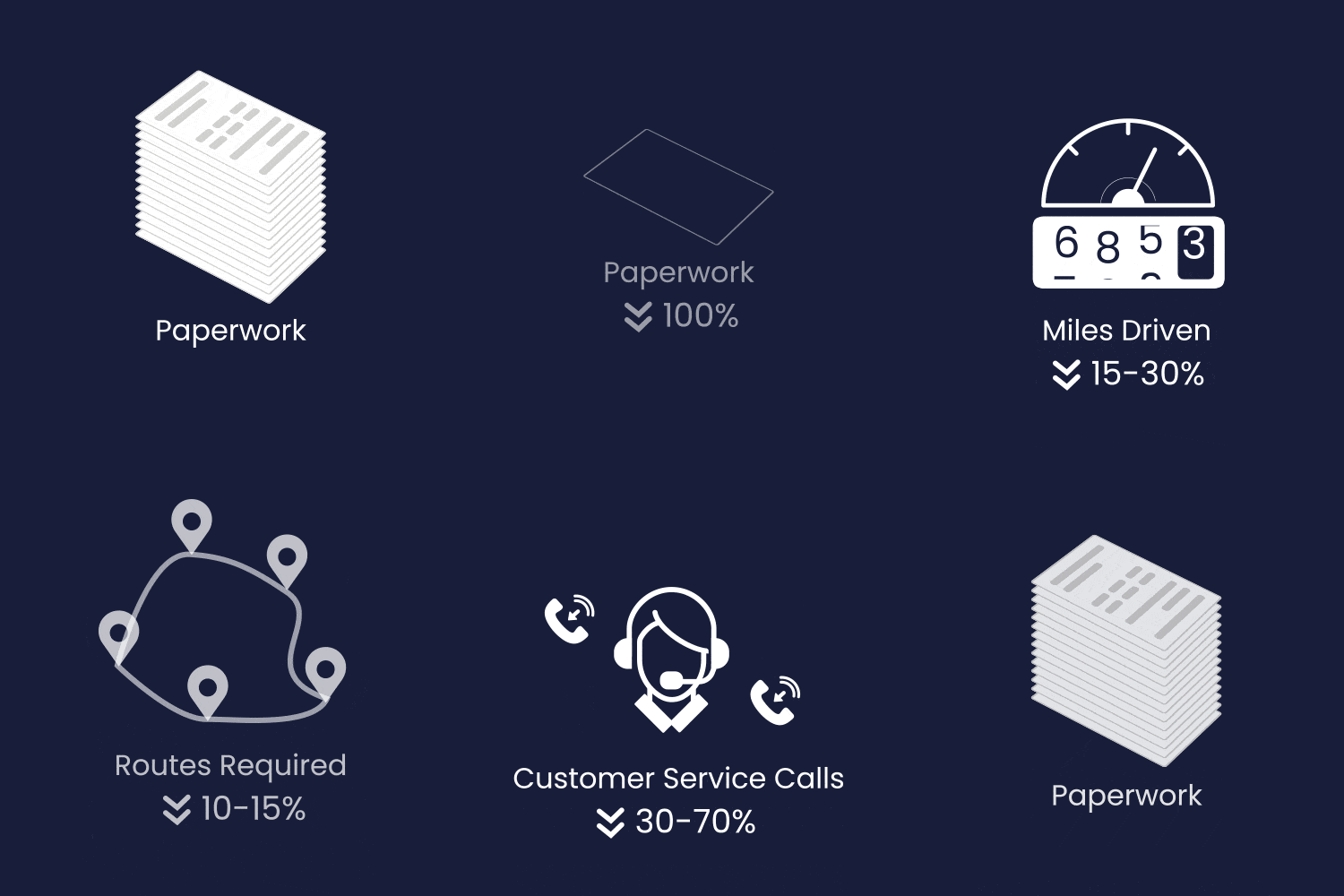
Data Insight: Implementing automated, multi-carrier software has been shown to reduce operational costs by up to 20% while simultaneously improving on-time delivery rates to 99%.
The Core Technology: Dynamic AI Route Optimization
To handle high-density, multi-stop scenarios, shippers are upgrading to Dynamic Route Optimization. Unlike static routing, dynamic routing builds the plan from scratch every single day based on actual order volume, traffic, and constraints.
How AI Solves the “Traveling Salesman Problem”
The “Traveling Salesman Problem” is a classic algorithmic puzzle: Given a list of cities and the distances between each pair of cities, what is the shortest possible route that visits each city exactly once and returns to the origin city?
When you scale this to 1,000 orders and 20 drivers, the possible combinations are in the trillions. AI-powered Logistics Software solves this in seconds.
Key Capabilities of Modern Route Optimization:
- Constraint-Based Routing: The software doesn’t just look at distance. It factors in:
- Time Windows: (e.g., “Customer needs delivery between 9 AM and 11 AM”).
- Vehicle Capacity: (Weight and Volume limits).
- Driver Skill Sets: (e.g., “Only Driver X is certified to handle hazardous materials”).
- Traffic Patterns: Using historical data to predict congestion at specific times of day.
- Real-Time Rerouting: If a new priority order comes in or a cancellation occurs, the AI instantly re-sequences the remaining stops to maintain optimal density.
Beyond Routing: The Role of Automated Dispatch
Planning the route is only step one. Assigning the right route to the right driver is step two. In high-density operations, Automated Dispatch removes the human bias and inefficiency from assignment.
The “Auto-Allocation” Engine
Modern platforms act as a central brain for your fleet. Instead of a dispatcher handing out clipboards, the system automatically pushes route manifests to drivers’ mobile apps.
● Smart Allocation
The system evaluates the entire fleet pool—including internal drivers and external 3PLs or crowdsourced fleets. It assigns the route to the lowest-cost option that can meet the delivery promise.
● Workload Balancing
The AI ensures that stops are distributed fairly. It prevents one driver from being overworked (leading to overtime costs and burnout) while another is underutilized.
● Seamless Integration:
This automation isn’t a standalone tool; it integrates directly with ERPs (like SAP or Oracle) to pull order data automatically, eliminating manual entry errors.
Slash your monthly fuel spend by removing unnecessary detours through AI-powered route logic. Start Cutting Costs
The Control Tower: Achieving Real-Time Visibility
In a manual environment, once a driver leaves the dock, they enter a “black hole.” The dispatcher has no idea where they are until they return or a customer calls to complain. High-density operations cannot survive this lack of visibility.
Shippers now utilize Control Tower dashboards—a single screen that visualizes the entire logistics network in real-time.
Reactive vs. Predictive Management
- The Old Way (Reactive): The customer calls to ask “Where is my order?” The dispatcher calls the driver. The driver checks their GPS. The information is relayed back. This takes 10–15 minutes per incident.
- The New Way (Predictive): The Control Tower flags an “Exception” automatically.
- Example: “Vehicle 4 is stuck in unexpected traffic and will miss the 2:00 PM delivery window.”
- Action: The dispatcher sees the alert instantly. They can drag-and-drop the stop to a nearby driver who is ahead of schedule, or the system can automatically notify the customer of the delay.
Real-Time GPS Tracking ensures that every stop is accounted for, and provides a digital audit trail that protects shippers against false claims of missed deliveries.
Customer Experience: Turning Delivery into a Brand Asset
In high-density delivery, the interaction with the customer is brief, but it defines the brand relationship. A missed delivery or a vague “8 AM to 8 PM” window is no longer acceptable.
Shippers utilize the same Last Mile TMS technology to empower the end customer, reducing anxiety and support tickets.
The “Uber-ization” of Delivery
Just as you track a ride-share vehicle approaching your curb, modern logistics software provides this level of visibility for packages.
● Predictive ETAs
Instead of a generic day, customers receive a precise window (e.g., “Arriving between 2:15 PM and 2:45 PM”).
● Live Tracking Links
An automated SMS or email provides a URL where the customer can watch the driver’s progress on a map.
● Direct Communication
Features often allow the customer to send notes directly to the driver (e.g., “Gate code is 1234” or “Leave package behind the planter”), ensuring the first delivery attempt is successful.
Impact on Support Costs: By providing proactive updates, businesses report a drastic reduction in “Where Is My Order?” (WISMO) calls—often by as much as 60%.
Turn your last-mile ‘blind spots’ into a competitive advantage with real-time delivery orchestration.
See the SolutionMeasuring Success: Key Metrics for High-Density Operations
You cannot improve what you do not measure. Moving to a digital platform allows shippers to track KPIs (Key Performance Indicators) that were previously impossible to calculate manually.
To master high-density delivery, shippers should obsess over these four metrics:
1. Cost Per Delivery (CPD)
The total cost of the route (fuel + labor + vehicle wear) divided by the number of successful drops. Goal: Drive this down through density.
2. On-Time Delivery Rate (OTD)
The percentage of deliveries made within the promised time window. Goal: 98%+.
3. First-Attempt Delivery Rate
The percentage of orders successfully delivered on the first try. Failed attempts destroy density because the package has to be returned and re-routed the next day.
4. Stops Per Mile
The ultimate density metric. How many revenue-generating stops is the vehicle making for every mile traveled?
| Metric | Manual Operations | AI-Powered Operations |
| Route Planning Time | 2–4 Hours | Minutes |
| On-Time Delivery | ~75% | ~98% |
| Fleet Utilization | ~60% | ~95% |
| Customer Visibility | None | 100% Live Tracking |
How nuVizz AI Powers High-Density Logistics
While many platforms claim to have “optimization,” true high-density efficiency requires more than just a calculator—it requires Artificial Intelligence.
nuVizz integrates advanced AI Agents and Machine Learning models directly into the logistics workflow, transforming the last mile from a reactive struggle into a predictive science.
The nuVizz AI Advantage:
● AI Agents for Smart Automation
nuVizz doesn’t just route vehicles; it manages the entire schedule. Our platform integrates AI agents for dynamic appointment scheduling, optimizing dock times and warehouse slots to minimize driver idle time and detention charges.
● Predictive Intelligence
Traditional systems report delays after they happen. nuVizz’s AI-powered decision-making engine analyzes patterns to predict delays before they happen, allowing dispatchers to reroute in real-time to avoid disruptions.
● Continuous Machine Learning
The software learns from your operations. By utilizing advanced machine learning algorithms, the platform constantly analyzes historical route data to improve density and speed over time, ensuring your fleet gets more efficient with every mile driven.
Ready to upgrade from manual planning to AI intelligence? Discover nuVizz AI Solutions
Conclusion: Future-Proofing Your Last Mile
The demand for high-density, multi-stop delivery is not a temporary trend—it is the new standard of global commerce. Shippers who continue to rely on manual processes or disconnected legacy systems will find their margins eroded by inefficiencies and their customers poached by faster, more transparent competitors.
By adopting AI-driven logistics software, shippers can finally solve the density puzzle. They can orchestrate complex, multi-stop routes with precision, turning the last mile from a cost center into a driver of growth and customer loyalty.
Ready to transform your delivery operations? Don’t let the last mile be the weak link in your supply chain.
Stop guessing. Start optimizing.
Talk to a nuVizz Expert Today