For decades, logistics has been an industry defined by “muscle.” Success was measured by how many trucks you owned, how large your warehouse was, and how many drivers you had on the payroll. If you had the assets, you had the advantage.
But in today’s on-demand economy, muscle is no longer enough. The modern supply chain—specifically the chaotic “last mile”—is not a test of strength; it is a test of intelligence.
Imagine a bodybuilder trying to navigate a crowded city street while blindfolded. They have the strength to move, but they lack the sensory input to move correctly. This is exactly how many logistics operations run today. They rely on legacy Transportation Management Systems (TMS) designed for long-haul freight—systems that are rigid, slow to react, and blind to the real-time nuances of doorstep delivery.
To survive the complexity of modern delivery (same-day windows, gig drivers, curbside pickups), logistics leaders need to stop focusing solely on the muscle and start building the brain. They need Last Mile Orchestration—a central nervous system that doesn’t just plan the movement of goods but intelligently directs it in real-time.
What is Last Mile Delivery Orchestration?
Last Mile Delivery Orchestration is the centralized management of the entire final-mile delivery ecosystem. Functioning as the “brain” of logistics, an Orchestration Platform integrates internal fleets, third-party carriers (3PLs), and gig drivers into a single, unified view. It uses Artificial Intelligence to automate decision-making, optimize routing across all carrier types, and ensure real-time visibility from the warehouse to the customer’s doorstep.
Unlike a traditional TMS, which often focuses on planning and procurement, an Orchestration Platform focuses on execution—ensuring that the right package gets on the right vehicle (whether it’s yours or a partner’s) at the optimal cost.
Anatomy of the “Logistics Brain”: Core Capabilities
A brain is useless if it cannot see the world, make decisions, or tell the body to move. Similarly, a Last Mile Orchestration platform (TMS) relies on three critical subsystems to navigate the complexity of modern logistics.
Here is how the “Brain” functions:
A. The Sensory System: Real-Time Visibility (Seeing the Chaos)
Before you can manage a fleet, you must be able to see it. However, traditional systems often suffer from “tunnel vision”—they can track their own trucks but go blind when a package is handed off to a 3rd party carrier or a gig driver.
- The Orchestration Advantage: A true Last Mile Brain ingests data from everywhere. It acts as a Control Tower, pulling in GPS streams from internal fleets, status updates from FedEx/UPS, and location data from crowd-sourced drivers.
- The Result: A single “pane of glass” where you can see every order, regardless of who is driving the vehicle.
B. The Decision Center: AI & Logic (Making the Choice)
This is where the magic happens. In the old days, a dispatcher looked at a pile of orders and decided which truck should take which route. Today, the volume is too high for humans to process alone.
- The Orchestration Advantage: The “Brain” uses advanced algorithms to make split-second decisions based on cost and capacity. It asks critical questions in milliseconds:
- “Is it cheaper to send our own truck, or is the destination too far off-route?”
- “Should we outsource this rush order to an Uber Direct or DoorDash driver?”
- “Does this delivery require a refrigerated truck?”
- The Result: Optimized Hybrid Fleet Management. The system automatically selects the best mode of transport for every specific order, balancing cost vs. speed without human bias.
C. The Nervous System: Automated Execution (Taking Action)
Once a decision is made, the brain must send a signal to the muscle. In logistics, this is the dispatch process.
- The Orchestration Advantage: Instead of a dispatcher picking up the phone, the system triggers Automated Dispatch. It pushes the route directly to the driver’s app. If a driver rejects the load or a vehicle breaks down, the “Nervous System” reacts instantly, re-routing the order to the next available driver or carrier.
- The Result: Seamless execution. The gap between “planning the route” and “driving the route” disappears.
How to bridge the gap between 3PL costs and 4PL results.
Read the GuideThe Missing Link: Standard TMS vs. Last Mile Orchestrator
Many logistics leaders make the mistake of thinking their Legacy TMS (Transportation Management System) can handle the last mile. While a Standard TMS is excellent for planning long-haul freight (moving pallets from factory to warehouse), it often lacks the agility required for the final mile (moving parcels from warehouse to doorstep).
Think of a Standard TMS as a train schedule: efficient, rigid, and planned weeks in advance. A Last Mile Orchestrator is more like a ride-share app: dynamic, reactive, and adjusting in real-time.
Here is why the “Brain” is different from the “Schedule”:
1. Planning vs. Execution
- Standard TMS: Focuses on procurement and planning. It excels at negotiating carrier rates and building static routes for the next day.
- Last Mile Orchestrator: Focuses on execution. It handles the “day-of” chaos—traffic jams, customer cancellations, and urgent on-demand orders—adjusting the plan as reality changes.
2. Asset-Centric vs. Network-Centric
- Standard TMS: Usually designed to manage assets you own (your trucks, your drivers). It struggles to seamlessly integrate data from gig fleets or local couriers.
- Last Mile Orchestrator: Is Carrier Neutral. It acts as a universal translator, connecting your internal fleet with 3rd party carriers (FedEx/UPS), crowdsourced drivers, and local couriers in one unified dashboard.
3. The “Black Box” vs. The “Glass Box”
- Standard TMS: Once the truck leaves the dock, visibility often goes dark until the driver returns or scans a POD at the end of the day.
- Last Mile Orchestrator: Provides granular, second-by-second visibility. It allows dispatchers (and customers) to see the driver’s location, battery status, and ETA in real-time.
Why You Need Both
This isn’t about throwing away your SAP or Oracle TMS. It’s about augmenting it. The Last Mile Orchestrator integrates with your upstream ERP/TMS, acting as the specialized “Brain” that takes the high-level plan and executes it with precision on the street level.
Tracking vs. Orchestration: What is the real difference? Compare Now
Business Impact: Why Intelligence Pays Off
Investing in an Orchestration Platform isn’t just a technical upgrade; it’s a financial strategy. When you replace manual guesswork with an intelligent “Brain,” you unlock efficiency gains that ripple through the entire organization.
Here is how the intelligence of a Last Mile Orchestrator translates into tangible business value:
| The “Brain” Function | Operational Gain (Efficiency) | Financial Gain (ROI) |
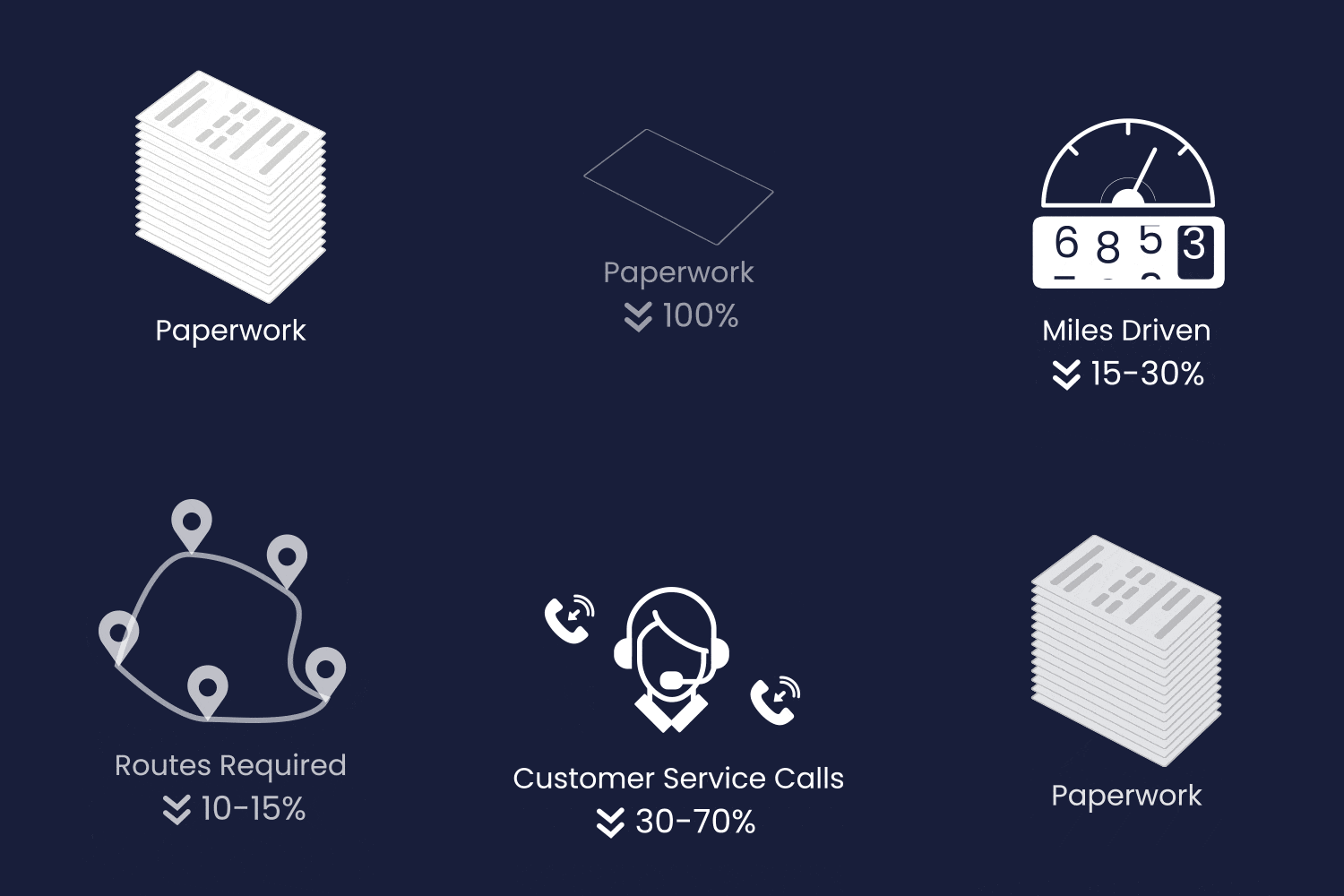
| Unified Visibility | Customer support teams can see every order in real-time without calling drivers. | Reduced Support Costs: Drastically cuts down “Where Is My Order?” (WISMO) calls, lowering call center volume by 30-40%. |
| Carrier Rate Shopping | The system automatically compares rates across internal fleets, 3PLs, and gig drivers for every package. | Lower Shipping Spend: Ensures you always choose the lowest-cost option that meets the service level agreement (SLA). |
| Automated Dispatch | Routes are assigned and optimized automatically without manual intervention. | Reduced Overhead: Dispatchers can manage 3x more drivers, or focus on managing exceptions rather than routine planning. |
| Hybrid Fleet Access | Seamlessly tap into gig networks (Uber/DoorDash) during peak demand. | Scalability without CAPEX: You can handle holiday spikes without buying more trucks or hiring temporary drivers on full-time contracts. |
The Hidden Value: Resilience
Beyond the numbers, the “Brain” offers resilience. When a disruption hits—like a snowstorm or a sudden driver shortage—an orchestrated system can pivot instantly. It can re-route orders to a third-party partner in seconds, preserving your brand promise when competitors are failing.
nuVizz – The “Omni-Rail” Orchestrator
If the Last Mile Platform is the brain, then it needs a nervous system that reaches everywhere. This is where nuVizz stands apart. We built our platform on a “Network-First” architecture, designed to break down the silos between different delivery models.
See how algorithms beat manual planning every time.
Optimize NowWe call this the “Omni-Rail” approach.
Just as a modern commuter might take a train, then a bus, and finally a scooter to get home, a modern package might need different modes of transport depending on the situation. nuVizz orchestrates this complex mix effortlessly.
Here is why leading enterprises trust nuVizz as their logistics brain:
● True Carrier Neutrality
Many platforms are good at managing your own trucks or managing FedEx shipments. nuVizz manages both—plus everything in between. Our platform connects your internal fleet, national carriers (UPS/FedEx), regional couriers, and on-demand gig drivers (Uber Direct, DoorDash) into one unified dashboard. You get a single view of the truth, no matter who is driving.
● Vertical Agnostic Flexibility
The “brain” needs to be adaptable. A pharmacy delivery (requiring signature and temperature check) is very different from a furniture delivery (requiring installation and photo proof). nuVizz workflows are highly configurable, allowing you to orchestrate distinct processes for different product lines within the same app.
● From Planning to Execution
nuVizz bridges the gap. We ingest high-level plans from your ERP or Legacy TMS and transform them into actionable, optimized routes on the street. We handle the real-world variables—traffic, delays, and exceptions—so your upstream systems don’t have to.
The nuVizz Difference: We don’t just track the delivery; we orchestrate the network. By empowering you to mix and match fleets dynamically, we ensure you never have to say “we can’t deliver that” to a customer.
Conclusion: The Smartest Network Wins
The days of winning on “muscle” alone are over. In the modern logistics landscape, having the most trucks or the biggest warehouses doesn’t guarantee success if you can’t navigate the complexity of the last mile with precision.
As customer expectations continue to rise and delivery windows continue to shrink, your logistics network needs more than just strength; it needs a brain. It needs a central nervous system that can see, think, and act in real-time.
Last Mile Orchestration is that brain. By integrating your planning, execution, and customer visibility into one intelligent platform, you turn chaos into a competitive advantage.
Equip Your Logistics Network with a Brain
Stop managing your fleet in the dark. Experience the power of true Delivery Orchestration with nuVizz. Let us show you how to connect your carriers, optimize your routes, and deliver the perfect last-mile experience.
Schedule a Demo with nuVizz