For mid-size logistics teams — managing anywhere from 15 to 150 drivers — growth creates a paradox. More delivery volume means more revenue, but also more complexity: more stops to sequence, more drivers to coordinate, more customer exceptions to handle. The instinctive response? Hire more dispatchers.
But there’s a smarter path.
AI-powered route planning software is fundamentally changing the economics of last-mile delivery for mid-size operations. Companies that once needed one dispatcher per 10 drivers are now running lean teams where a single dispatcher confidently manages 25–30 routes — with better on-time performance, lower fuel spend, and higher customer satisfaction scores than ever before.
This blog breaks down the real ROI levers, what to expect from implementation, and how to evaluate route planning software that pays for itself — without adding a single new hire.
The Hidden Cost of Manual Route Planning
Most mid-size logistics teams underestimate how much manual route planning is actually costing them — because the inefficiencies are invisible. They’re not on a single line item. They’re spread across fuel bills, overtime records, failed delivery reports, and dispatcher salaries.
Here’s what the operational reality looks like before modern route optimization:
Excess fuel consumption
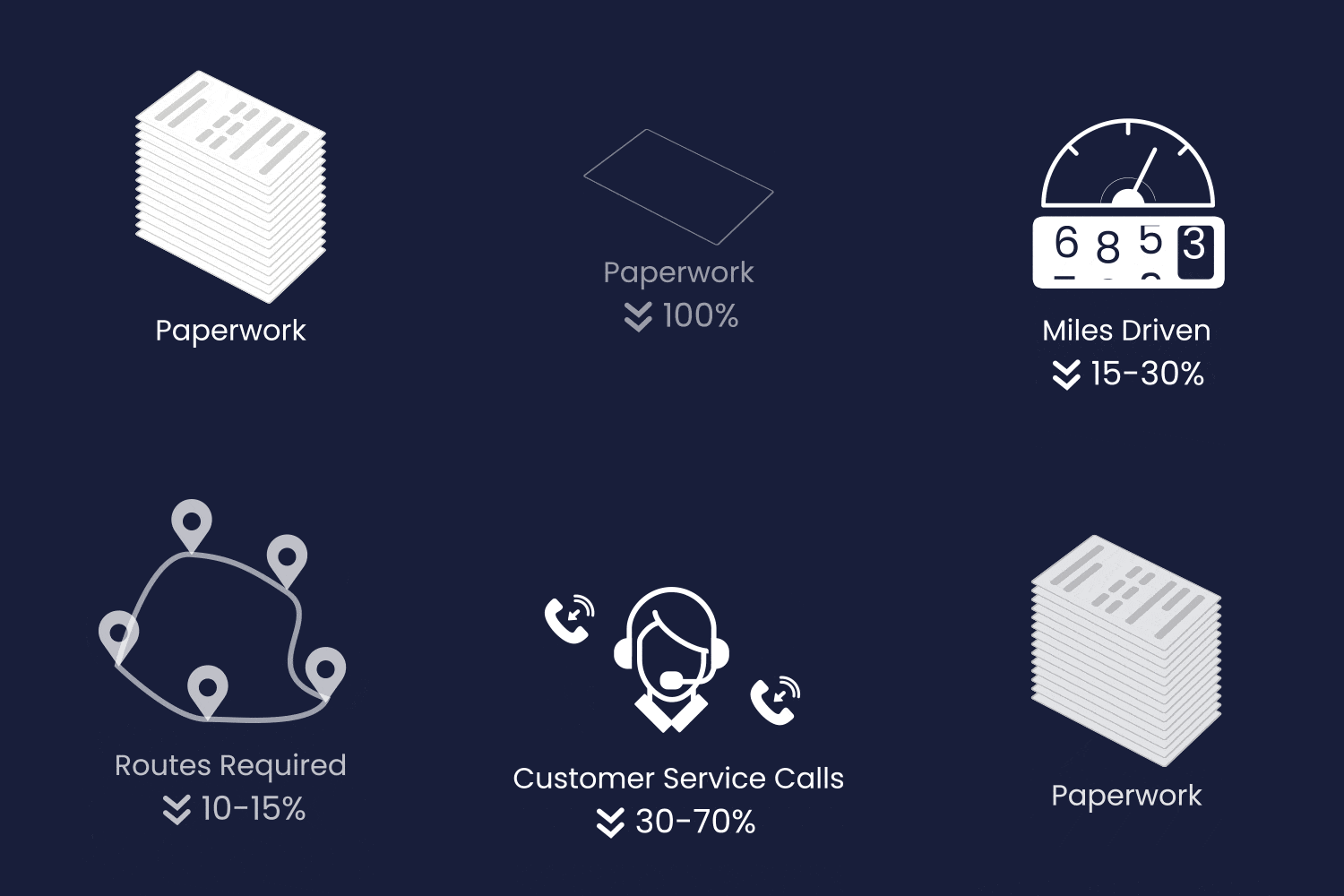
Drivers take routes based on familiarity or dispatcher habit — not mathematical efficiency. The result is 15–30% more miles driven than necessary, every single day.
Dispatcher overtime
Route building for the next day routinely bleeds into evening hours. Exception handling — urgent add-ons, customer reschedules, last-minute cancellations — pulls dispatchers away from planning and into reactive firefighting.
Failed first-attempt deliveries
Without accurate ETAs or real-time customer notifications, recipients aren’t ready. Failed deliveries cost an average of $17–$25 per attempt to re-execute, and they destroy customer trust.
No visibility, no accountability
When something goes wrong mid-route, dispatchers are flying blind — calling drivers, guessing ETAs, manually relaying status updates to customers.
Scaling means hiring
Every time volume grows, the assumption is: add another dispatcher. This model has a ceiling — and a painful cost curve.
The good news: every one of these pain points is directly addressable with the right route planning platform.
Missed delivery timelines hurting your retail experience? Fix it with advanced shipping software.
Get StartedFive Ways Route Planning Software Delivers Measurable ROI
For mid-size logistics teams, every dollar spent on technology needs to justify itself — quickly. The good news is that route planning software doesn’t deliver ROI through one single lever; it creates a compounding effect across multiple cost centers simultaneously. From the fuel your drivers burn to the overtime your dispatchers clock, the savings stack up fast. Here are the five most impactful ways AI-powered route planning software puts money back into your operations.
1. Fuel & Mileage Reduction
AI-powered route optimization doesn’t just find the shortest path — it finds the most efficient sequence of stops, accounting for time windows, vehicle capacity, traffic patterns, and driver shift constraints simultaneously. nuVizz customers have seen up to 20% reduction in total driven miles post-deployment. For a fleet running 50 vehicles covering 200 miles/day at $0.18/mile, that’s over $65,000 in annual fuel savings alone.
2. Dispatcher Productivity Gains
Route planning software automates what used to take dispatchers 2–4 hours every evening: stop sequencing, load balancing, driver assignment, and schedule optimization. With platforms like nuVizz’s RoboDispatch™, this happens automatically. One dispatcher can now manage 2–3× more routes — meaning you scale volume without scaling headcount.
3. Elimination of Failed Deliveries
With real-time customer ETA notifications and AI-driven address correction first-attempt delivery rates climb to 97%+. Fewer re-deliveries means lower cost-per-delivery and stronger customer retention.
4. Overtime Elimination
When route building is automated and exception handling is handled by intelligent re-routing — not by frantic dispatcher phone calls — overtime shrinks dramatically. Teams report 30–50% reductions in dispatcher overtime hours within the first quarter of deployment.
5. Billing Accuracy & Revenue Leakage Prevention
Manual billing processes cause revenue leakage — unbilled stops, incorrect rate card application, disputed deliveries. Route planning software with integrated billing modules automates driver settlement using configurable rate cards, eliminating billing errors and recovering 2–5% of revenue that previously slipped through the cracks.
ROI Breakdown: Before vs. After
| Cost Area | Before Route Optimization | After Route Optimization | Typical Saving |
| Fuel / Mileage | 100% of baseline | 75–85% of baseline | 15–25% |
| Dispatcher Labor | 1 dispatcher per 10 routes | 1 dispatcher per 25–30 routes | 50–60% labor efficiency gain |
| Failed Deliveries | 8–12% failure rate | Under 3% failure rate | $17–25 saved per averted re-delivery |
| Overtime Hours | 10–20 hrs/week per dispatcher | 2–5 hrs/week per dispatcher | 30–50% overtime reduction |
| Billing Errors | 3–6% revenue leakage | Under 1% leakage | 2–5% revenue recovery |
| Payback Period | — | — | 3–6 months |
Scaling Without Hiring: How AI Does the Heavy Lifting
The single biggest ROI unlock for mid-size logistics teams isn’t fuel savings — it’s operational leverage. The ability to grow delivery volume without a proportional increase in headcount.
Here’s how AI-powered platforms create that leverage:
Automated Stop Sequencing
Instead of a dispatcher manually ordering 80 stops across 8 drivers, the algorithm evaluates millions of permutations in seconds — considering time windows, vehicle capacity, driver hours-of-service, and customer priorities simultaneously.
Dynamic Re-Routing
When a driver runs late, a stop is added last-minute, or traffic blocks a corridor, the platform automatically recalculates affected routes and notifies both drivers and customers — without dispatcher intervention.
RoboDispatch™
RoboDispatch™ allows customers to self-enter orders that are automatically assigned, routed, and dispatched — removing dispatchers from the intake loop entirely for standard orders.
Network-Wide Visibility
A single operations dashboard gives supervisors real-time visibility across every driver, route, and delivery — enabling proactive management rather than reactive firefighting.
The result: your existing team becomes exponentially more capable. One operations manager described it as “going from air traffic controlling 10 planes manually to managing 40 with radar.”
Struggling with tracking sensitive medical shipments? Take control with live updates.Get StartedWhat to Look for in Route Planning Software
Not all route planning platforms are built for mid-size logistics complexity. Here’s what to prioritize:
✅ AI-Driven Dynamic Routing
Not just static route templates, but live re-optimization as conditions change during the day.
✅ Multi-Fleet & Multi-Carrier Support
Ability to manage private fleet, contract carriers, and crowdsourced drivers on a single platform.
✅ Real-Time Customer Notifications
Automated ETA updates via SMS/email reduce inbound “where is my delivery?” calls by 60–80%.
✅ Proof of Delivery (POD) Capture
Photo, signature, barcode scan — all timestamped and geo-tagged for dispute resolution.
✅ Integrated Billing & Settlement
Configurable rate cards that auto-calculate driver settlements and customer invoices based on actual delivery data.
✅ Open API & ERP Integration
Seamless connection to your existing WMS, ERP, or order management system without ripping and replacing your stack.
✅ HIPAA / SOC2 / ISO 27001 Compliance
Essential if you operate in healthcare, pharma, or food logistics verticals.
nuVizz’s platform is purpose-built to deliver all of the above within a single, network-based Last Mile TMS — without requiring multiple point solutions stitched together.
Implementation Timeline for Mid-Size Teams
One of the most common objections to adopting route planning software is fear of disruption. The reality for a mid-size team is far more manageable than most expect:
Weeks 1–2 | Discovery & Integration Map existing workflows, configure ERP/WMS integrations, define route zones and driver profiles, import historical stop data.
Weeks 3–4 | Pilot Route Testing Run 2–3 live routes in parallel with existing process. Compare outcomes on distance, time, fuel, and dispatcher effort. Refine configuration.
Week 5 | Dispatcher & Driver Training Dispatcher training on the planning console typically takes 4–6 hours. Driver app onboarding averages under 30 minutes per driver.
Weeks 6–8 | Full Rollout Gradual expansion across all routes. Daily ops review during first two weeks to address edge cases and fine-tune optimization parameters.
Month 3 onwards | ROI Measurement Formal reporting against baseline KPIs — miles driven, cost-per-delivery, on-time rate, dispatcher hours, overtime spend.
Most nuVizz customers are fully operational within 6–8 weeks and begin seeing measurable cost reductions within the first month of live operations.
Conclusion
The economics of last-mile delivery are shifting. Mid-size logistics teams that continue to rely on manual route planning will find themselves outcompeted — not because their people aren’t capable, but because their competitors are running the same routes smarter, faster, and cheaper with AI.
Route planning software doesn’t replace your operations team. It makes them dramatically more powerful. One dispatcher managing 30 routes with real-time visibility, automated customer notifications, and AI-backed exception handling isn’t just more efficient — they deliver a fundamentally better customer experience.
The question isn’t whether the ROI is there. At 3–6 months to payback, it consistently is. The question is how much longer you’ll wait before capturing it.
nuVizz’s AI-powered Last Mile TMS is purpose-built for exactly this challenge. From RoboDispatch™ to Vizzard AI to real-time network visibility — every feature is designed to help mid-size logistics teams do more with the team they already have.
Ready to see your ROI potential? Request a Demo → or Explore the Platform →