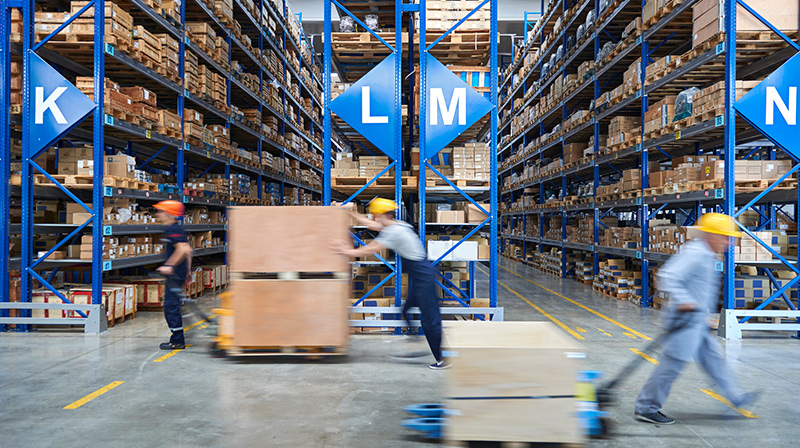
For years, logistics providers treated the warehouse and the delivery van/truck as two separate worlds. The “Warehouse” was about storage and efficiency; the “Last Mile” was about drivers and doorsteps. However, in the modern supply chain—where Pharma requires instant traceability and Retail demands same-day arrival—that wall has crumbled.
The Shift: From Transportation-Centric to Fulfillment-Centric
The industry is undergoing a massive paradigm shift. We are realizing that the last mile is won or lost before the truck even leaves the bay. In the past, last-mile success was measured by how fast a driver could navigate traffic. Today, success is defined by order readiness. If a warehouse takes four hours to pick and stage an order, even the fastest driver cannot meet a “same-day” promise. The last mile is no longer just about trucks; it is about the orchestration of data from the moment an order is placed to the moment it is scanned out of the loading dock.
Bridging the “Visibility Gap” with nuVizz
The primary challenge for most enterprises is the “Visibility Gap”—the dark period between an item being picked and the delivery carrier taking possession.
nuVizz solves this by offering a Unified Logistics approach. By integrating Warehouse Management (WMS) capabilities directly with Last-Mile execution, nuVizz creates a seamless flow of information. This ensures:
● Real-time Synchronization
The delivery team knows exactly when a high-priority pharma shipment is ready for pickup.
● Order Integrity
Retailers can guarantee stock availability by linking warehouse inventory levels directly to the customer’s checkout screen.
● Supply Chain Orchestration
Transforming a series of disconnected steps into a single, fluid motion from the storage bin to the final destination.
By treating the warehouse as the “launchpad” rather than a storage unit, businesses can finally master the complexities of modern fulfillment.
Pharma Logistics: Accuracy and Compliance as a Foundation
In the pharmaceutical world, “Last-Mile Success” isn’t just about a package arriving on time—it’s about patient safety and regulatory survival.
DSCSA & Traceability: The Digital Breadcrumb Trail
With the Drug Supply Chain Security Act (DSCSA) requirements becoming more stringent, pharmacies and distributors must provide full traceability. A WMS isn’t just managing boxes; it’s managing data packets.
● Serialized Tracking
nuVizz ensures that every unit is scanned and verified at the warehouse level so that the digital “pedigree” follows the medication through the last mile.
● Chain of Custody
Real-time integration ensures that when a driver picks up a controlled substance, the WMS instantly updates the record of possession.
Cold Chain Integrity: Beyond the Refrigerator
For biologics and vaccines, the last mile is a race against the clock and temperature.
● Staging Intelligence
An integrated WMS alerts the warehouse team to pick and stage temperature-sensitive goods only when the specialized last-mile vehicle is within a specific proximity.
● Proactive Alerts
By linking WMS sensor data with last-mile telematics, dispatchers can see if a shipment’s temperature is deviating before it reaches the patient.
The “Zero-Error” Mandate
In retail, a wrong shirt size is an inconvenience. In pharma, a wrong dosage is a liability. By utilizing AI-driven picking within the WMS, nuVizz minimizes human error at the source, ensuring that the “Last Mile” starts with 100% order accuracy.
Struggling to control fleet costs and driver productivity as a small business?
Explore Fleet Management SolutionsAgility and Personalization: The Retail Revolution
In the “Amazon Era,” customer loyalty is built on two things: speed and transparency. For retailers, achieving this means the Warehouse Management System (WMS) must do more than just track pallets—it must act as the nerve center for Omnichannel Agility.
The Rise of Micro-Fulfillment Centers (MFCs)
To meet 2-hour or same-day delivery windows, inventory must live closer to the customer. This has given rise to Micro-Fulfillment Centers—small, often automated hubs tucked into urban basements, “dark stores,” or the backrooms of existing retail locations.
● Why it needs WMS
Without a robust WMS, managing stock across dozens of tiny hubs is an inventory nightmare. nuVizz provides the real-time visibility needed to ensure that high-velocity items are stocked in the right urban hub before the morning rush.
● The Last-Mile Payoff
By slashing the distance between the shelf and the doorstep, retailers significantly reduce fuel costs and carbon footprints while meeting the “instant gratification” demand.
Mastering Omnichannel: From SFS to BOPIS
Modern retail isn’t just one-way traffic; it’s a web of fulfillment options. A unified WMS-Last Mile platform enables:
● Ship-from-Store (SFS)
Turning every retail storefront into a mini-warehouse, allowing local drivers to pick up orders directly from the store floor.
● Buy Online, Pick Up In-Store (BOPIS)
Ensuring that when a customer walks into a store to collect an order, the WMS has already alerted the team to pick, pack, and stage it in the “ready” zone.
● Inventory Accuracy
Nothing kills a brand faster than a customer “buying” an item online only to receive a “cancelled due to stock error” email. nuVizz eliminates “ghost inventory” by syncing warehouse counts with the online storefront in real-time.
Reverse Logistics: The “New Normal” for Retail
Returns are a significant part of the retail lifecycle. An integrated WMS doesn’t just push goods out; it pulls them back in efficiently.
● Speed to Re-sell
When a driver picks up a return at the doorstep, platforms can pre-alert the warehouse. Once it arrives, the WMS ensures it is inspected and moved back into the “sellable” stream immediately, rather than sitting in a corner for weeks.
AI is reshaping logistics fast—stay ahead with the trends that matter in 2026. Explore AI Logistics Trends
How WMS Optimizes the Final Delivery
The difference between a standard warehouse and a “last-mile-ready” warehouse lies in the technology. To power last-mile success, a WMS must look beyond its own walls and anticipate the needs of the driver and the end customer.
Route-Sequenced Picking: Loading for Efficiency
Traditional warehouses pick by zone or by item type. A last-mile-optimized Warehouse management software uses Route-Sequenced Picking.
● The Logic
The WMS communicates with the Last-Mile delivery engine to understand the driver’s stop sequence.
● The Result
Items for the last stop are loaded first, and items for the first stop are loaded last (LIFO—Last In, First Out). This prevents drivers from digging through a crowded van at the curb, saving 2–5 minutes per stop—a massive cumulative gain over a full route.
Cross-Docking: The “Express Lane” for Logistics
For high-velocity retail or urgent pharma supplies, storage is often a waste of time.
● Dynamic Flow
Integrated WMS allows for Advanced Cross-Docking, where incoming shipments from suppliers are scanned and immediately moved to an outbound delivery vehicle without ever being put away on a shelf.
● Speed
This reduces “dwell time” to near zero, ensuring that products are in transit to the customer almost as soon as they arrive at the facility.
Real-Time Inventory Synchronization
One of the biggest causes of last-mile failure is the “Information Gap”—when a website says an item is in stock, but the warehouse can’t find it.
● Unified Data
By maintaining a single source of truth, these platforms ensure that the inventory seen by the warehouse manager, the delivery driver, and the end customer is identical.
● Eliminating “Ghost Orders”
This technical handshake prevents the operational nightmare of dispatching a driver for an order that doesn’t exist.
The Data Dividend: Visibility from Bin to Doorbell
Data is the “connective tissue” of the modern supply chain. When you integrate WMS with the last mile, you stop managing individual tasks and start managing an end-to-end lifecycle.
● The Control Tower Concept
nuVizz provides a “Control Tower” view. A logistics manager can see if a delay in the picking aisle will cause a driver to miss their 4:00 PM delivery window in another city.
● Predictive Analytics
By analyzing warehouse throughput data, the system can predict “bottleneck hours” and suggest earlier dispatch times to ensure last-mile commitments are met.
● Proactive Customer Communication
Because the system knows exactly when an item leaves the picking bin and hits the truck, it can send hyper-accurate “Your order is being prepared” and “Your order is on the way” notifications, reducing customer service inquiries (WISMO—”Where Is My Order?” calls).
Conclusion
In the high-stakes industries of Pharma and Retail, the warehouse is no longer just a storage facility—it is the strategic engine of the last mile. As we have seen, success at the customer’s doorstep is a direct result of order readiness, data synchronization, and technical orchestration at the loading dock.
By breaking down the silos between WMS and Last-Mile delivery, nuVizz empowers businesses to:
- Achieve 100% Transparency: From the picking bin to the patient or consumer.
- Reduce Operational Costs: Through route-sequenced picking and automated staging.
- Future-Proof Logistics: Adapting to the 2026 trends of micro-fulfillment and AI-driven predictive planning.
Don’t let your last-mile success be hindered by a legacy warehouse. It’s time to unify your logistics and turn your fulfillment process into a competitive advantage.
Ready to bridge the gap? Book a nuVizz Demo Today